How many hours does it take to transform a campus-based university module to online learning?

recent post on WONKHE, the higher education policy news site stated that it takes 80 hours to convert an existing module into an online or blended one. WONKHE gave no details for where this number came from other than academics had repeatedly mentioned it as the time required.

This comes as no surprise; speaking with hundreds of educators across the sector, we know that, on average, it will take 80 hours to transform a module from face to face delivery with lectures and seminars to high quality online or blended delivery.

WONKHE

I want to do a thought experiment for fun as to where these hours might go. I will make many assumptions, so comment at the bottom to correct me or suggest better hypotheses to use. 

My first assumption is that the 80 hours are on top of the existing workload allocation. The module team would use the standard hours for prep and delivery of live (synchronous) learning and facilitation of on-demand (asynchronous) learning.

Assuming the average university module is 20 credits, and one credit is equal to 10 hours of notional learning, students should spend 200 hours on average completing each module. 

The term ‘notional learning time’ is used to denote all time expected to be spent by a student in pursuit of a higher education qualification. This includes independent study and reading, preparation for contact hours, coursework, revision and summative assessment. This term is used because the actual time that learners need to achieve designated learning outcomes varies considerably. Notional study time of ten hours per credit is the agreed tariff that higher education providers use in designing their programmes and learning outcomes for higher education qualifications, with 360 credits making up an honours degree.

QAA.ac.uk

Let us assume that a module might be delivered over half an academic year, over 15 weeks, with a one hour lecture and two one hour small group seminars per week as contact time. That would mean that the academic would have 45 hours of teaching time to convert from campus-based to entirely online or a blend of online and campus-based. The other 155 hours would be made up of independent study and working on assessments. This conversion is due to the pandemic, so the independent study and assessment would probably not change too much, even if the assessment is transformed from a three-hour exam to a 24-hour open book exam done remotely.

So, 80 hours to convert 45 hours of teaching to online learning.

Let us further assume that the seminars will stay live (synchronous) through Microsoft Teams or Zoom or, if they are lucky with rooming and social distancing, stay live on campus. That gives us 15 hours of online content and activities to create to replace lectures. 

So, 80 hours to convert 15 hours of teaching to online learning. Suppose the academic spends four hours redesigning their module through a workshop activity like ABC, and six hours of training and experimentation to use the software. In that case, this gives our fictional academic 70 hours to create 15 hours of online content and activities for our made-up module.

70 hours of development time to produce 15 hours of video content, text, activities, and self-mark questions mean 4 hours and 40 minutes of development time per hour of online learning. 

Let us say that each one hour lecture is 40 minutes of content and then 20 minutes of discussion and answering questions on an audience response tool like Mentimeter. If we allocate 40 minutes of development time to set up a discussion forum and convert the questions to the VLE quiz tool, that leaves four hours to develop four ten minute videos or one hour per ten-minute video.

To sum up, a Module Leader might spend 80 hours converting their existing module to online:

  • 6 hours of training
  • 4 hours of design using the ABC model
  • 70 hours creating content
    • 1 hour for each 10-minute video
    • 40 minutes for each 20 minute activity time

This is a tough ask for academics that may not have the digital skills or technology at the start of the pandemic to transform their modules in just 80 additional hours. It is important to note that these 80 hours will not have been given to academics within their usual workload but instead done on top of everything else.

Let me know what you think in the comments or via Twitter if you want some discussion.
Linkedin Learning’s Workplace Learning Report 2021

Linkedin released their 5th annual Workplace Learning Report today. The findings are collected from Linkedin’s learning and development survey, completed by over 5,000 professionals across 27 countries.

65% of L&D pros have a seat at the exec table, up from 24% last year. This increase is mostly due to the need’s for remote working during the pandemic. 57% of L&D professionals say learning & development as moved from a ‘nice to have’ to a ‘need to have’.

The focus of Learning and Development in companies in 2021 is upskilling and reskilling, with 59% of companies saying this is their priority. The need for new skills can be partly attributed to the digitalisation of many roles. According to the World Economic Forum, 85 million jobs will be displaced, and 97 million new jobs will be created globally by 2025 due to computing playing a larger part in many businesses. The pandemic has accelerated many companies plans for digitisation and the training staff to take advantage of the new technologies. Leadership and management (53%), Virtual onboarding (33%), and Diversity and inclusion (33%) are the other most common priorities. The two most essential skills are resilience and digital fluency to address the pace of change. 

The skills gap created by increase technology in the workplace has lead companies to focus more on internal mobility, giving employees extra motivation to engage in learning and development. 51% of UK companies now say that internal mobility is more important now that pre-pandemic. To support internal employee progression, 39% of L%D professionals are currently identifying skills gaps in their organisation, and 33% are developing tools to help develop programmes targeted at upward or adjacent moves of employees within the company. The report suggests that employees at companies with high internal mobility stay almost twice as long; an average of 2.9 years for low internal mobility companies and 5. years where internal mobility is high. 

Community is becoming a crucial part of learning programmes. At Linkedin learning’s internal programmes, learners who used the platform’s social features watched an average of 30 times more content. This mirrored in the feelings of Learning and Development professionals in the survey. 84% said that learning is more engaging when done with other people, 94% said that it is more successful, and 95% said it helps create a sense of belonging. 

Linkedin Learnings own programmes have seen a 58% increase in users in the last year to 25 million global users; each user is watching on average twice the number of hours. Generation Z, born between 1995-2010, are the top uses of Linkedin Learning, growing 2.5 times the number of users in this bracket, and they are watching 50% more hours.

The five most popular Linkedin Learning courses for learning and development professionals:

  1. Instructional Design Essentials: Models of ID by Joe Pulichino
  2. Articulate Storyline Essential Training by Daniel Brigham
  3. Instructional Design: Storyboarding by Daniel Brigham
  4. Converting Face-to-Face Training into Digital Learning by Daniel Brigham
  5. Measuring Learning Effectiveness by Jeff Toister

Gravity Assist, the Office for Students new digital teaching and learning review

On the 25th of February, The Office for Students released their digital teaching and learning review paper titled Gravity assist: propelling higher education towards a brighter future. The report states that in November 2020, 93% of undergraduates and 89% of postgraduate students received most or all their learning digitally. The scale of change is impressive when you consider that 47% of the academics questioned had no digital teaching experience before the pandemic. Universities have done in weeks what most had planned to do over the next five to ten years.

The sudden move online has effected teaching student satisfaction; 67% of students polled said they were content with their digital teaching, and 61% said it was in line with their expectations. 29% of students said teaching was worse than expected, and 48% said they had not been asked for feedback on teaching by their institution. The lack of satisfaction can be explained by only 21% of teachers saying they were very confident they had the skills to design and deliver digital teaching and learning, and 20% are not confident in their skills for the new teaching methods.  

Some of the changes enforced by lockdowns will have a lasting impact on the workplace and the classroom. The report found that 70% of academic staff think digital learning and teaching represent exciting future delivery opportunities. The report suggests five key benefits of online learning: increased flexibility, personalised learning, increased career prospects, pedagogical opportunities, and global opportunities.

The six components of successful digital teaching and learning

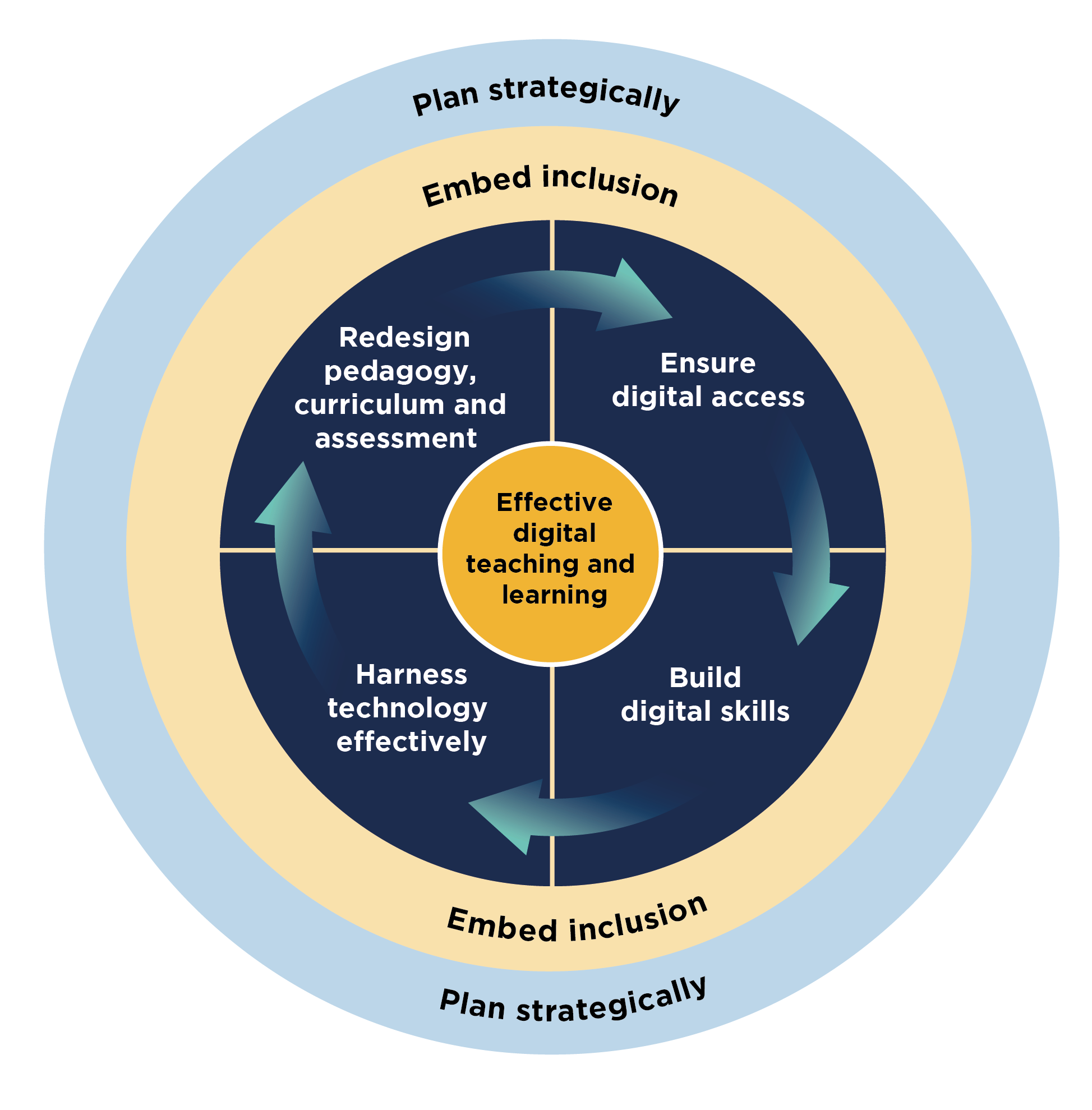
The paper provides a model for good digital learning and teaching. The model involves six core components to help universities define quality online and blended learning and then create a plan to achieve it:

  1. Digital teaching must start with appropriately designed pedagogy, curriculum and assessment.
  2. Students must have access to the right digital infrastructure.
  3. Good access enables staff and students to build the digital skills necessary to engage.
  4. Technology can then be harnessed strategically, rather than in a piecemeal or reactive way, to drive educational experience and outcomes.
  5. Inclusion for different student groups must be embedded from the outset.
  6. All the elements need to be underpinned by a consistent strategy. 

Recommendations

The lessons identified by the gravity assist paper and the core components generated from them have been condensed into a set of recommendations for high-quality digital learning:

  1. Redesign pedagogy, curriculum and assessment
    1. Design teaching and learning specifically for digital delivery using a ‘pedagogy-first’ approach.
    2. Co-design digital teaching and learning with students at every point in the design process.
    3. Seize the opportunity to reconsider how assessments align with intended learning outcomes.
  2. Ensure digital access
    1. Proactively assess students’ digital access on an individual basis and develop personalised action plans to mitigate any issues identified.
    2. Build learning and procure technology around the digital access actually available to students, not the access they would have in a perfect world
  3. Build digital skills
    1. Communicate clearly to students the digital skills they need for their course, ideally before their course starts.
    2. Create mechanisms that allow students to track their digital skills throughout their course and allow these skills to be recognised and showcased to employers.
    3. Support staff to develop digital skills by incentivising excellence and continuous improvement.
  4. Harness technology effectively
    1. Streamline technology for digital teaching and learning and use it consistently as far as possible.
    2. Involve students and staff in decisions about the digital infrastructure that will be used and how it will be implemented.
    3. Foster a culture of openness to change and encourage calculated risk-taking.
  5. Embed inclusion
    1. Review and evaluate whether provision is inclusive and accessible.
    2. Design inclusively, build a sense of belonging and complement this with tailored support for individual students.
    3. Adapt safeguarding practices for the digital environment
  6. Plan strategically
    1. Ensure a strong student voice informs every aspect of strategic planning.
    2. Embed a commitment to high-quality digital teaching and learning in every part of the organisation.
    3. Proactively reflect on the approach to the digital and physical campuses.

Six actions for 2021-22

Universities are currently planning the 2021/21 academic year, and the paper included a checklist of considerations that align with the recommendations.

  1. Assess students’ digital access on a one-to-one basis and address issues before learning is lost
  2. Inform students what digital skills they will need
  3. Involve students in designing teaching and learning
  4. Equip staff with the right skills and resources
  5. Make the digital environment safe for all students
  6. Plan how you will seize the opportunity for the longer-term

The paper is not regulatory guidance, but the clear message is that Universities should be moving to blended learning long-term. Institutions should be reflecting on the progress and challenges of the 2020/21 academic year and use the recommendations to plan out the future direction of their delivery model.

There is a big focus on digital access and skills for students. The access recommendations include assessing students’ digital access on an individual basis to put in place mitigations that allow them to continue learning, and design learning around the technology students have available. Simple solutions include:

  • Stating a courses technology needs for students before they start.
  • Creating accessible materials.
  • Considering bandwidth limitations.
  • Making asynchronous alternatives to live events available to students with limited or unreliable internet.  

The six actions do not present anything surprising, but this might represent an acknowledgement of the work that has been done this year by academics and professional services staff to move to online and blended learning. The one notable exception is within action three, to have a mechanism to involve students in learning design beyond the usual feedback opportunities. Each of the action points for co-design involves student feedback, so it is not clear if students should be directly involved in learning design or just an effort to increase the feedback collected and a need for increased responsiveness to it. What is clear is that student feedback needs to far more regular than mid-module and the end of module reviews, and academic will have to be prepared to update their delivery quickly in response.

You can read the full report on the Office for Students website. Let me know on Twitter what you think.