Narrowing the digital divide

To learn online, you need a stable internet connection and an internet-enabled device such as laptops or smartphones. However, when the March 2020 lockdown hit in the UK and universities and schools moved online, 11% of households did not have access to the internet, according to the Office of Communications (OFCOM). One year later and that number was down to 6%.

A new OFCOM report on Adults’ Media Use and Attitudes published on the 28th of April states that “The pandemic had been the catalyst for a step-change in digital skills…” but warned that 1.5 million UK homes still do not have access to the internet. The research showed that 10% of users access the internet via a smartphone only, and 20% of children did not have constant access to a device for online learning during the lockdowns.

The recent Office for Students guidance paper found that around 30% of university students surveyed lacked good internet access, and 30% lacked a suitable study space. If the 30% from the survey translates to the whole 2.38 million UK student population, that is roughly 300,000 students with digital access issues. 

During a regular year, this would have been covered by on-campus facilities. The University I work at provides computers in study spaces across its campuses, includes a computer finder tool in the student app, and high-speed internet in all its accommodation. But with social distancing and full lockdowns, these facilities were in limited supply, halls become the primary social spaces as external spaces were forced to close, and many students found themselves returning home to shared devices, bandwidth, and workspaces with parents and siblings. 

The Gravity assist paper recommends that university providers make digital access a priority:

  • Appropriate hardware for students to access course content with parity of experience. 
  • Appropriate software for students to access course content
  • Robust technical infrastructure that works seamlessly and repaired promptly
  • Reliable access to the internet with sufficient bandwidth
  • A trained teacher or instructor equipt to deliver high-quality digital learning and teaching 
  • An appropriate study place that is quiet and consistently avalible

Most universities have adapted to the challenge, providing year-long laptop loans, broadband dongles, and technical support to those students that need it. Academics have rapidly upskilled with digital teaching practices and redesigning courses to adapt to the changing access to students. Software vendors like Microsoft and Virtual Learning Environment vendors like D2L have adapted too, rapidly releasing new tools and dramatically increasing infrastructure to handle the shift to online. 

Many of these fixes were put in place as short-term solutions, and universities, academics, and tech companies must now find long-term solutions that do not disadvantage this 30% of students. The Office for students suggests that institutions start to engage with students individually before their courses start. Universities should offer solutions where needed, such as loaning laptops, financial support, and creative study space solutions, in the same way other additional needs are currently handled.

Flexible learning should hold an advantage for students from the most deprived areas of the UK, allowing them to study around their many additional commitments caring responsibilities, part-time work, and commutes. Significant progress has been made over the last twelve months to provide equal access to higher education; we need to put the same level of planning into maintaining digital access for all.  
Gravity Assist, the Office for Students new digital teaching and learning review

On the 25th of February, The Office for Students released their digital teaching and learning review paper titled Gravity assist: propelling higher education towards a brighter future. The report states that in November 2020, 93% of undergraduates and 89% of postgraduate students received most or all their learning digitally. The scale of change is impressive when you consider that 47% of the academics questioned had no digital teaching experience before the pandemic. Universities have done in weeks what most had planned to do over the next five to ten years.

The sudden move online has effected teaching student satisfaction; 67% of students polled said they were content with their digital teaching, and 61% said it was in line with their expectations. 29% of students said teaching was worse than expected, and 48% said they had not been asked for feedback on teaching by their institution. The lack of satisfaction can be explained by only 21% of teachers saying they were very confident they had the skills to design and deliver digital teaching and learning, and 20% are not confident in their skills for the new teaching methods.  

Some of the changes enforced by lockdowns will have a lasting impact on the workplace and the classroom. The report found that 70% of academic staff think digital learning and teaching represent exciting future delivery opportunities. The report suggests five key benefits of online learning: increased flexibility, personalised learning, increased career prospects, pedagogical opportunities, and global opportunities.

The six components of successful digital teaching and learning

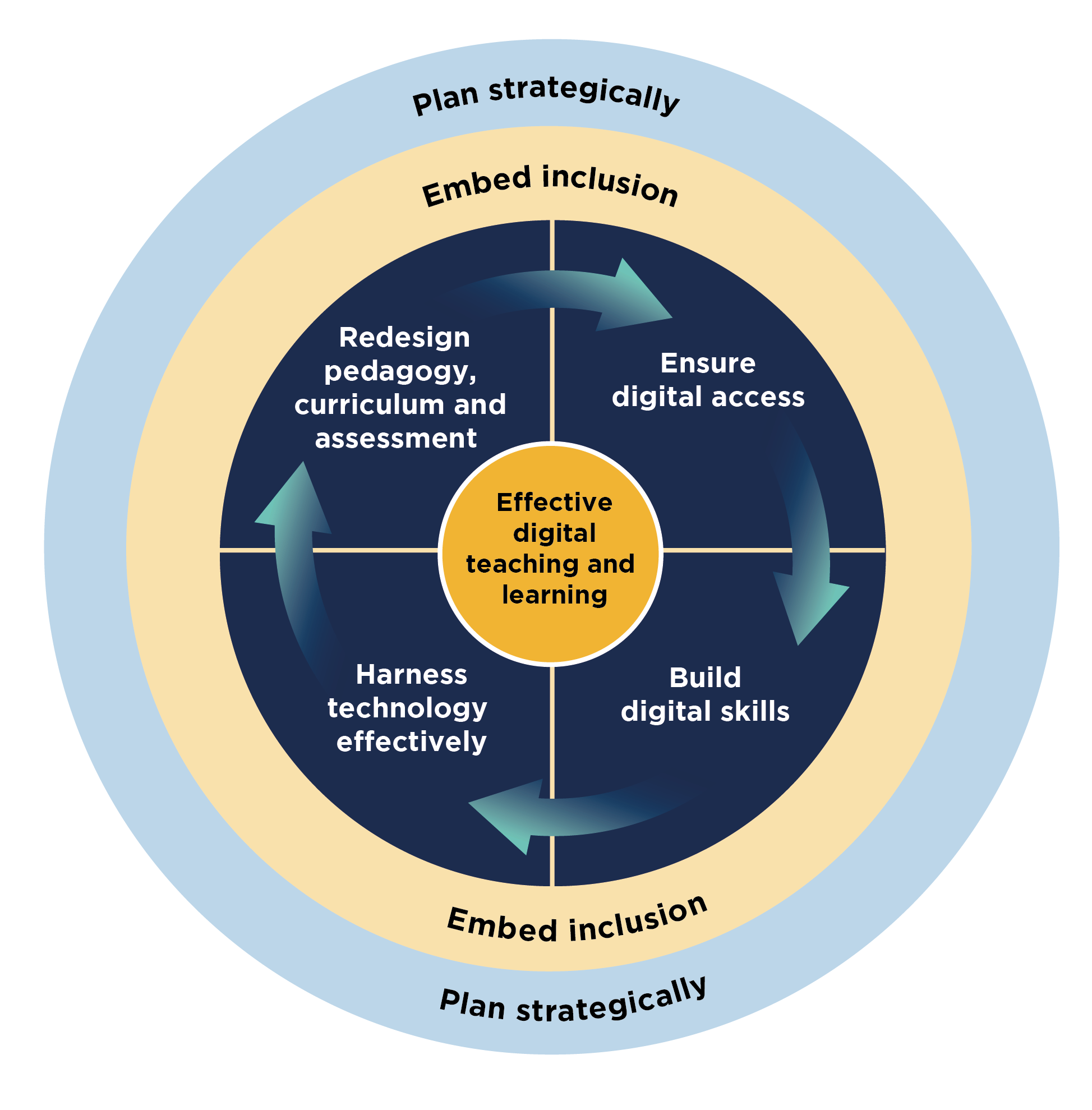
The paper provides a model for good digital learning and teaching. The model involves six core components to help universities define quality online and blended learning and then create a plan to achieve it:

  1. Digital teaching must start with appropriately designed pedagogy, curriculum and assessment.
  2. Students must have access to the right digital infrastructure.
  3. Good access enables staff and students to build the digital skills necessary to engage.
  4. Technology can then be harnessed strategically, rather than in a piecemeal or reactive way, to drive educational experience and outcomes.
  5. Inclusion for different student groups must be embedded from the outset.
  6. All the elements need to be underpinned by a consistent strategy. 

Recommendations

The lessons identified by the gravity assist paper and the core components generated from them have been condensed into a set of recommendations for high-quality digital learning:

  1. Redesign pedagogy, curriculum and assessment
    1. Design teaching and learning specifically for digital delivery using a ‘pedagogy-first’ approach.
    2. Co-design digital teaching and learning with students at every point in the design process.
    3. Seize the opportunity to reconsider how assessments align with intended learning outcomes.
  2. Ensure digital access
    1. Proactively assess students’ digital access on an individual basis and develop personalised action plans to mitigate any issues identified.
    2. Build learning and procure technology around the digital access actually available to students, not the access they would have in a perfect world
  3. Build digital skills
    1. Communicate clearly to students the digital skills they need for their course, ideally before their course starts.
    2. Create mechanisms that allow students to track their digital skills throughout their course and allow these skills to be recognised and showcased to employers.
    3. Support staff to develop digital skills by incentivising excellence and continuous improvement.
  4. Harness technology effectively
    1. Streamline technology for digital teaching and learning and use it consistently as far as possible.
    2. Involve students and staff in decisions about the digital infrastructure that will be used and how it will be implemented.
    3. Foster a culture of openness to change and encourage calculated risk-taking.
  5. Embed inclusion
    1. Review and evaluate whether provision is inclusive and accessible.
    2. Design inclusively, build a sense of belonging and complement this with tailored support for individual students.
    3. Adapt safeguarding practices for the digital environment
  6. Plan strategically
    1. Ensure a strong student voice informs every aspect of strategic planning.
    2. Embed a commitment to high-quality digital teaching and learning in every part of the organisation.
    3. Proactively reflect on the approach to the digital and physical campuses.

Six actions for 2021-22

Universities are currently planning the 2021/21 academic year, and the paper included a checklist of considerations that align with the recommendations.

  1. Assess students’ digital access on a one-to-one basis and address issues before learning is lost
  2. Inform students what digital skills they will need
  3. Involve students in designing teaching and learning
  4. Equip staff with the right skills and resources
  5. Make the digital environment safe for all students
  6. Plan how you will seize the opportunity for the longer-term

The paper is not regulatory guidance, but the clear message is that Universities should be moving to blended learning long-term. Institutions should be reflecting on the progress and challenges of the 2020/21 academic year and use the recommendations to plan out the future direction of their delivery model.

There is a big focus on digital access and skills for students. The access recommendations include assessing students’ digital access on an individual basis to put in place mitigations that allow them to continue learning, and design learning around the technology students have available. Simple solutions include:

  • Stating a courses technology needs for students before they start.
  • Creating accessible materials.
  • Considering bandwidth limitations.
  • Making asynchronous alternatives to live events available to students with limited or unreliable internet.  

The six actions do not present anything surprising, but this might represent an acknowledgement of the work that has been done this year by academics and professional services staff to move to online and blended learning. The one notable exception is within action three, to have a mechanism to involve students in learning design beyond the usual feedback opportunities. Each of the action points for co-design involves student feedback, so it is not clear if students should be directly involved in learning design or just an effort to increase the feedback collected and a need for increased responsiveness to it. What is clear is that student feedback needs to far more regular than mid-module and the end of module reviews, and academic will have to be prepared to update their delivery quickly in response.

You can read the full report on the Office for Students website. Let me know on Twitter what you think.