Time to dust off the running shoes

After a two month break and on the first sunny weekend of the year, it is time to dust off the running shoes. My current project 4w/kg programme runs until the 1st of May, and I want to be ready to move to a running focus once this goal is achieved. Preparing to run will involve gradually prepare my body for an attack on the next step in the distance runners progression; a 40 minute 10k.

The first job is to lose some body fat and get down to a body weight that is more suited to running fast. Losing weight while maintaining power is key to achieving the four watts per kilogramme needed for project 4w/kg, so this is already on the schedule. Running is a series of single-leg jumps, and the lighter you are, the less force is needed to perform each jump. The less useless weight, the less effort to go the same speed, and so the same effort will take you faster. Carrying a bit of extra weight (3-4kg) over the winter has been healthy, and I have enjoyed eating everything in sight, but with the winter coming to an end, it is time to get a bit leaner. Weight loss happens in the kitchen, and I know all I need to do to get down to my target of 80kg is to clean up my diet and stop eating all the treats.

The greatest need for all athletes is strength. More and more strength.

Percy Cerutty

While I am losing body fat, I also want to build a runners body. I am already doing a heavyweight session twice per week as part of my bike programme. Still, the frequency of my gymnastics and core work, stretching, and general physical preparation could be increased. Percy Cerutty’s 100 sit-ups first thing in the morning and a range of strength and conditioning four-minute movement breaks focused on the hips, core, and hamstrings will support the weight loss to prepare the body to run fast. Kelly Starret, in his book Ready to Run, provides twelve standards that will help build the runners body:

  1. Neutral feet
  2. Flat shoes
  3. A supple thoracic spine
  4. An efficient squatting technique
  5. Hip flexion
  6. Hip Extention
  7. Ankle range of motion
  8. Warm-up and cool down
  9. Compression
  10. No hotspots
  11. Hydration
  12. Jumping and landing

Most importantly, runners run, so I need to slowly get back into regular running. 5k Masters record holder, coach, and author of Fast 5k, Pete Magil, suggests that all runners should start with a run-walk programme to avoid injury and build strength in the key muscles. Brad Hudson’s short and intense hill sprints can also improve running form and condition alongside the run walks. Finally, G. Walter George’s 100-up exercise can be done once per day to develop stride length in place of going out for a run. 

The plan

  • Monday: run/walk am, light rite of passage workout
  • Tuesday: bike am, weight session with 8-10 second hill sprints pm
  • Wednesday: bike am, run/walk and medium rite of passage workout pm
  • Thursday bike am, 
  • Friday: run/walk am, weights session with run drills and 8-10 second hill sprints pm
  • Saturday: bike am, heavy rite of passage workout and optional run/walk pm
  • Sunday: bike am

Daily core, stretch, and strength routine as 4-minute movement breaks

  • 100 Sit-ups first thing in the morning
  • Planks directly before I start work
  • 75-150 kettlebell swings
  • 100-ups
  • Light Deadlifts: five sets of 10 reps @40kg

The plan might look a lot written down, but the only two heavy workouts are the Tuesday and Sunday bike sessions. The other activities are lighter and should not affect the next sessions. In the current training phase, the strength sessions are there to maintain strength rather than build it.
A 30 day time block scheduling challenge

Working from home has been good for my productivity. I am fitter and healthier than ever before, my work output has increased significantly, and I have been able to publish a daily blog. Work has moved on from the project-based approach used to manage to move a whole university online, and so the way I work needs to evolve too.

Removing the commute has given me an hour and a half of extra time each day, and working from home has given me more freedom around my working hours to focus on output rather than time in the office. I have used this time to train twice per day for the last year consistently; some cardio at 7 am each morning, some strength training or recovery work in the afternoon for 45 minutes to an hour between 16:00 and 18:00, and four-minute movement breaks where they fit throughout the day. The output so far has been a 1:35 half marathon, a 308w FTP on the bike, a 120kg Squat, a 100kg bench press, and a 142.5kg Deadlift, while weighing around 82kg and at 6ft tall.

I have written over 100 daily blog posts so far by finding around an hour each evening after dinner, between 19:00 and 20:00, to do some research, write, and publish it. I loosely aim to write somewhere in the region of 500 words to keep within the time and force myself to be concise. We consume so much content these days between articles on our phones, youtube videos, and reading for work, that I write about whatever I think about or consuming that day. I have found many of the posts useful for work; I have reused some of the content for work when the topic has been raised, sometimes weeks later.

My morning and evening routines outside of work are highly structured, but my working hours have to be more reactive. Universities have moved all, or most, of their teaching online, and so those of us in online learning has never been busier. This week I stopped my teams daily stand-ups. Our work is moving from project-based to a new normal, the daily meetings had become more social events than supporting productivity, so it is time to reassess how I use my working hours to have more of an impact. I want to be more deliberate with my time during work in a similar way to my strength and conditioning training and writing practice.

Time blocking

The first step of any productivity system is to spend five minutes writing a task list at the start of the day. Most people stop at this stage and then start with the first item or might prioritise the list and start with the most important. This approach presents two issues; the first is that tasks tend to expand to fill the time available, known as Parkinson’s law. The second is that we are not good at estimating the time something will take to block out space in our calendar. To solve these issues, we need to track how long tasks take consistently, and then we need to use this knowledge to block out that a suitable amount of time to complete the task efficiently.

Schedule every minute of your working day

For the next thirty days, I will follow a time blocking routine to be more deliberate in the use of my time and focus on the work that is going to impact students’ experience in the new academic year.

The practice:

  1. Write down what you want to do at the start of the day.
  2. Estimate how long each of these items will take.
  3. Schedule these blocks of time in 30-minute chunks around your existing commitments.
  4. Follow your schedule; at any point you deviate from it, update the plan for the rest of the day by moving the unfinished blocks as required.
  5. Make a note of how long each task took next to your estimate and assess why you were wrong – use this knowledge to help you schedule similar tasks in the future.

Let me know on Twitter if you want to try time blocking your workday too. A remember, the aim is to take control of your day and learn to plan your time better, not to be fixed to a schedule.

Gravity Assist, the Office for Students new digital teaching and learning review

On the 25th of February, The Office for Students released their digital teaching and learning review paper titled Gravity assist: propelling higher education towards a brighter future. The report states that in November 2020, 93% of undergraduates and 89% of postgraduate students received most or all their learning digitally. The scale of change is impressive when you consider that 47% of the academics questioned had no digital teaching experience before the pandemic. Universities have done in weeks what most had planned to do over the next five to ten years.

The sudden move online has effected teaching student satisfaction; 67% of students polled said they were content with their digital teaching, and 61% said it was in line with their expectations. 29% of students said teaching was worse than expected, and 48% said they had not been asked for feedback on teaching by their institution. The lack of satisfaction can be explained by only 21% of teachers saying they were very confident they had the skills to design and deliver digital teaching and learning, and 20% are not confident in their skills for the new teaching methods.  

Some of the changes enforced by lockdowns will have a lasting impact on the workplace and the classroom. The report found that 70% of academic staff think digital learning and teaching represent exciting future delivery opportunities. The report suggests five key benefits of online learning: increased flexibility, personalised learning, increased career prospects, pedagogical opportunities, and global opportunities.

The six components of successful digital teaching and learning

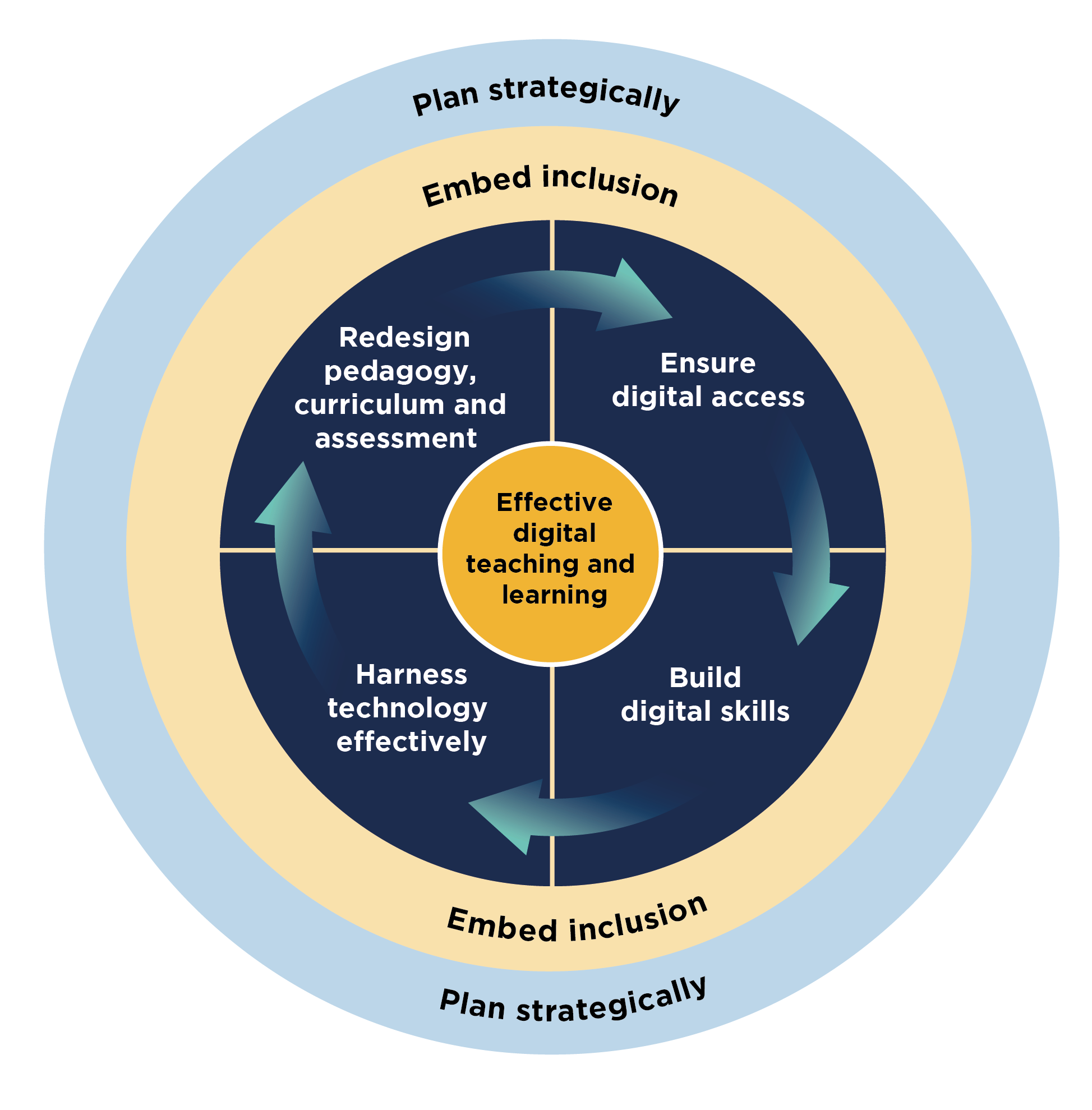
The paper provides a model for good digital learning and teaching. The model involves six core components to help universities define quality online and blended learning and then create a plan to achieve it:

  1. Digital teaching must start with appropriately designed pedagogy, curriculum and assessment.
  2. Students must have access to the right digital infrastructure.
  3. Good access enables staff and students to build the digital skills necessary to engage.
  4. Technology can then be harnessed strategically, rather than in a piecemeal or reactive way, to drive educational experience and outcomes.
  5. Inclusion for different student groups must be embedded from the outset.
  6. All the elements need to be underpinned by a consistent strategy. 

Recommendations

The lessons identified by the gravity assist paper and the core components generated from them have been condensed into a set of recommendations for high-quality digital learning:

  1. Redesign pedagogy, curriculum and assessment
    1. Design teaching and learning specifically for digital delivery using a ‘pedagogy-first’ approach.
    2. Co-design digital teaching and learning with students at every point in the design process.
    3. Seize the opportunity to reconsider how assessments align with intended learning outcomes.
  2. Ensure digital access
    1. Proactively assess students’ digital access on an individual basis and develop personalised action plans to mitigate any issues identified.
    2. Build learning and procure technology around the digital access actually available to students, not the access they would have in a perfect world
  3. Build digital skills
    1. Communicate clearly to students the digital skills they need for their course, ideally before their course starts.
    2. Create mechanisms that allow students to track their digital skills throughout their course and allow these skills to be recognised and showcased to employers.
    3. Support staff to develop digital skills by incentivising excellence and continuous improvement.
  4. Harness technology effectively
    1. Streamline technology for digital teaching and learning and use it consistently as far as possible.
    2. Involve students and staff in decisions about the digital infrastructure that will be used and how it will be implemented.
    3. Foster a culture of openness to change and encourage calculated risk-taking.
  5. Embed inclusion
    1. Review and evaluate whether provision is inclusive and accessible.
    2. Design inclusively, build a sense of belonging and complement this with tailored support for individual students.
    3. Adapt safeguarding practices for the digital environment
  6. Plan strategically
    1. Ensure a strong student voice informs every aspect of strategic planning.
    2. Embed a commitment to high-quality digital teaching and learning in every part of the organisation.
    3. Proactively reflect on the approach to the digital and physical campuses.

Six actions for 2021-22

Universities are currently planning the 2021/21 academic year, and the paper included a checklist of considerations that align with the recommendations.

  1. Assess students’ digital access on a one-to-one basis and address issues before learning is lost
  2. Inform students what digital skills they will need
  3. Involve students in designing teaching and learning
  4. Equip staff with the right skills and resources
  5. Make the digital environment safe for all students
  6. Plan how you will seize the opportunity for the longer-term

The paper is not regulatory guidance, but the clear message is that Universities should be moving to blended learning long-term. Institutions should be reflecting on the progress and challenges of the 2020/21 academic year and use the recommendations to plan out the future direction of their delivery model.

There is a big focus on digital access and skills for students. The access recommendations include assessing students’ digital access on an individual basis to put in place mitigations that allow them to continue learning, and design learning around the technology students have available. Simple solutions include:

  • Stating a courses technology needs for students before they start.
  • Creating accessible materials.
  • Considering bandwidth limitations.
  • Making asynchronous alternatives to live events available to students with limited or unreliable internet.  

The six actions do not present anything surprising, but this might represent an acknowledgement of the work that has been done this year by academics and professional services staff to move to online and blended learning. The one notable exception is within action three, to have a mechanism to involve students in learning design beyond the usual feedback opportunities. Each of the action points for co-design involves student feedback, so it is not clear if students should be directly involved in learning design or just an effort to increase the feedback collected and a need for increased responsiveness to it. What is clear is that student feedback needs to far more regular than mid-module and the end of module reviews, and academic will have to be prepared to update their delivery quickly in response.

You can read the full report on the Office for Students website. Let me know on Twitter what you think.

The MBA where your teacher is a machine

Quantic.edu, formally Smart.ly, is an online MBA programme built by a former CEO of the Rosetta Stone language learning company. It is based on self-paced learning driven by questioning and then supported by live sessions for traditional discussion of case studies and group work. The aim is to make high-quality education cheaper, quicker, cheaper, and better at delivering outcomes. They have taken the learning by testing idea that has made Rosetta Stone so successful and repurposed it to help people learn business skills. 

To make education cheaper, the programmes primary instructor is software, which is then supported by live classes with humans. Around 80% of the cost of a degree in America is staff costs, so replacing the lecture with self-paced learning allows Quantic to offer their Executive MBA for just $9,600, significantly cheaper than other similar programmes. The programme is also quicker, taking 11 months to complete compared to the 18-24 months of a regular executive MBA. 

The company offers its regular MBA for free to the student. It acts as a recruiter, placing its graduates in jobs with tech firms like Apple, Google, Amazon, and Facebook, looking for a talented individual, and then charges the company a recruitment fee. They have been innovative with their admissions process too. Once a prospective student applies, they have to go through the self-paced business Foundations’ courses in the period before their submission is accepted, with the engagement in these courses being a part of the acceptance criteria.

The real innovation is in their active learning teaching method. The website states that there is individualised feedback every eight seconds. The free course I took averaged around fifty words to a page and taught through questioning the questions’ difficulty gradually increasing as your confidence builds. These tests are presumably ‘low stakes’, meaning your answers are not recorded, but rather it’s part of the teaching method to give regular feedback and allow you to get it wrong and provide the solution to correct you.

Research – just as good as a traditional MBA

A July 2016 study by Stanford University academics compared learning from Quantics’s online model to on-campus MBAs for finance and accounting modules. Quantic participants took a pre-test, completed a self-paced course, and then took a post-test. On-campus MBA students took only the post-test. The study concludes that ‘Preliminary analyses show learners in the Quantic groups performed as well as or better than MBA participants at post-test.’

The Quantic students improve an average of 29 percentage points in accounting and 33 percentage points in Finance from pre-test to post-test. The average post-test score was 86% (accounting) and 82% (Finance), which was 11% higher for accounting and 1% higher for Finance than the on-campus MBA students’ scores in the same test. Students also like it; Quantic received similar net promoter scores to Harvard and Wharton MBA programmes in the study but has since improved on this by introducing their blended model that supports machine-driven learning with live classes.

“This study supports the assertion that some of the foundational accounting and financial concepts taught in traditional brick-and-mortar MBA program can be learned independently, online through Pedago’s targeted Quantic active-learning courses. Significant improvement in students’ knowledge can be gained in as little as two hours of engagement with these courses.” Quantic efficacy study

The self-paced courses are not enough on their own. The study suggests that the materials be used as part of an MBA programme that includes cohort-based elements alongside. The two suggestions were for the machine taught content to acts as introductory materials before the MBA starts or as prerequisites to live sessions in a flipped learning approach.

If acting as introductory materials at the start of the course, they can enhance students understanding of fundamental ideas in hard to learn areas or bring students up to a similar starting level—the Prerequisite work for blended-learning classes. If used as prerequisite learning between live sessions, it can leave instructors more classroom time to explore case studies and interact with peers in group work. 

Podego – The tesla of education – cheaper and quicker to learn 

Quantic is run by Pedago, a private company that aims to ‘build an end-to-end talent engine.’ They state that the fourth industrial revolution is leading to disruption of the labour market, removing or changing the jobs people do, and that technology can help people become smarter and re-skill in the new job market.

Education + career matching = Talent engine

Podego

They want to be the ‘Tesla of education’, using technology to making it cheaper and quicker to learn new skills, using technology and new approaches. One such method is eliminating the lecture and replacing it with discovery-based learning, replacing the lecturer with a computer, and focusing on interactivity and personalised feedback and progression, supported by live online classes with humans.

They state that Quantic is the worlds first accredited, machine taught degree and that it is specifically designed for access on mobile as that is where modern students want to learn. Their MBA is their first course and acts as a proof of concept and aim to move into teaching programming, blockchain, robotics, and other subjects that represent a skills gap in the economy. 

The Education company of the future

MAKE IT ACCESSIBLE: We’re mobile-first, platform-agnostic, self-paced, and easily-translatable into every major language.

MAKE IT AFFORDABLE: We remove the cost barrier and the heavy student debt burden, ensuring access regardless of socioeconomic status.

MAKE CREDENTIALS VALUABLE: We admit students for degrees and certificates based on prerequisites and prospects for employment.

TIE IT TO CAREER: We link education directly to its ultimate benefit, motivating financial gain, career advancement and personal fulfilment.

MONETISE ON THE EMPLOYER: We help companies match with the ideal job-seeking student, with the desired skills, education, and culture fit, paying upon a successful hire in our career network.

Podego

I highly recommend you sign up for their free courses and experiment with the Quantic learning method. If I took anything from exploring a couple of their introductory courses, it was the idea of tracking the number of interactions a student gets in their on-demand content. Self-paced learning in courses is essential to make the class time more valuable but can often rely too heavily on content and not enough testing. Moving to a metric of ‘seconds per interactions’ might be too much of a jump for current HE lecturers, but ‘minutes per interaction’ might improve the student experience significantly. 

Three Pedagogic approaches

Most people teach as part of their everyday lives and become good at it. They develop their teaching as an art, learning to explain things clearly, be patient, sharing just enough but not too much, and learning to read people to see if they have understood. For those who teach as a profession, we must take this art and add science to approach teaching systematically. This science helps us understand how learning happens, how to organise teaching to improve its effectiveness, what works for learners, and how we assess that learning occurred.

Pedagogy the method and practice of teaching that attempts to collect the science of learning into practical application. Three common types of learning pedagogies are: 

  • Didactic
  • Authentic
  • Transformative.

Didactic pedagogy is an effective method for large scale education in groups and teaching the basics of education, such as reading, writing, and discipline. It is a teacher-led approach where they, along with textbooks, are the authority of knowledge, and students absorb this knowledge presented to them often with little critical investigation or questioning of the source. University modules that involve a series of lectures and readings followed by a written exam where the student is questioned on the material is an example of didactic pedagogy.

Authentic pedagogy is learner-centred and expects the student to participate in the knowledge transfer and understand the learning through real-life experiences. There is less emphasis on learning through repetition but rather through building understanding from the ground up through self-direct inquiry, problem-solving, and reflection. This can be a slow and involved process, it requires a solid base of the basics, and not everything needs a deep level of understanding. Inquiry-based learning is an excellent example of authentic pedagogy. Students are given questions, problems, or scenarios and are expected to do their own research and then present their findings. 

Transformative pedagogy recognises the changing nature of technology and modern society and that knowledge may not currently exist to address what students need to learn. Instead, transformative approaches focus on problem solving, co-design, and producing new knowledge. One method of transformative pedagogy is project-based learning, where students are presented with a question or issue as a starting point; they then have work to produce a product to address it.  

These three teaching approaches have a place in the modern classroom and in preparing students for the world after university. There is a level of basic facts, knowledge and processes that are needed. Students then need to learn to question authority and established norms to develop a deeper understanding of the world. Finally, learners need to be able to deal with incomplete problems and generate new knowledge and approaches specific to the context they are in. If you were designing a higher learning course, you might even want to divide it into three discrete stages, building from didactic to authentic and finishing with transformative learning…  

Solving problems with the double diamond design process model

Traditional project management starts with a brief, and you go through several steps to get to a solution. In the Double Diamond, this is called the design phase and involves a period of divergence followed by convergence. The divergence and convergence process is done twice, first to go from problem to design brief, and second to go from the brief to the solution.

Divergence and convergence

The most crucial concept in solving any problem is to have multiple ideas and then chose the best. Before committing to a solution to develop, you need first to think up and test multiple ideas to find the best one.

Divergent thinking is a thought process or method used to generate creative ideas by exploring many possible solutions.

Wikipedia

Convergent thinking is the type of thinking that focuses on coming up with the single, well-established answer to a problem.

Wikipedia

You will have done this process of divergent then convergent thinking in school many times. First, you brainstorming as many ideas as possible, not worrying about the quality of what you are writing, then you choose the ones that sound the most suitable and investigate them further. Finally, you select one single idea that performs best in your tests. This process was to train you on how to think about a problem and come to a solution.

Designing things right and designing the right things

Designing things right requires a design process where the problem definition is used to develop, test, and deliver a solution. You collate many potential solutions by generating ideas and then trying them. You can then deliver solutions that work to users and listen to their feedback to refine your solution further. 

The best designers spend time designing the right thing first by researching the problem to create a problem definition or design brief. You need to gain insights into the challenge through exhaustive research and then scope down the focus by exploring this research to come to a clear definition.

The Double Diamond design process model

The British Design Council published the double diamond as a visual representation of the design and innovation process in 2004, adapting it from similar iterative models used by IDEO and the divergence-convergence model. The aim was to produce a simple way to share a strategic approach to a design and innovation project. The Double Diamond was published alongside the Methods Bank resource to define the British Design Council’s innovation process.

The double diamond collects divergent and convergent thinking ideas and design principles and the Methods bank to create an innovation process that you can use in any field.

The design process has four stages:

  • Discover – question the problem and research to identify users needs
  • Define – make sense of the discovery phase findings to create a design brief
  • Develop – develop, test, and refine multiple potential solutions
  • Deliver – Select and prepare a final solution for launch

Design principles:

  • Be people-centred
  • Communicate visually and inclusively
  • Collaborate and co-create
  • Iterate, iterate, iterate

Methods bank

  • Explore: challenges, need, and opportunities
  • Shape: prototypes insights and visions
  • Build: ideas, plans, and expertise 

Learn more on the Design Council’s website.

The Knowledge Exchange Framework (KEF)

English universities have two core excellence frameworks, the REF and TEF, which judge the institution’s output quality. The REF or Research Excellence Framework assesses the quality of research at an institution, supports the allocation of research funding, provides accountability of that funding, and offers a benchmark for universities. The TEF or Teaching Excellence Framework assesses teaching quality by measuring how a university supports students to succeed and gain graduate-level employment or entry to further study. The performance of these two markers is directly linked to rankings and funding. A third Framework has been introduced that does not yet have any formal impact but might be a better way of measuring a university’s impact on society. 

The Knowledge Exchange Framework (KEF)

“The aim of the Knowledge Exchange Framework (KEF) is to increase efficiency and effectiveness in the use of public funding for knowledge exchange (KE) and to further a culture of continuous improvement in universities.” Research England

The Kef measures the impact of academic research by assessing the institution against the activities described in the HE-BCI survey data, a measure of interactions with businesses and the community. The range of activities includes involving industry and the public sector in research, consultancy, the commercialisation of intellectual property, and activities that have societal benefits, such as Continuing Professional Development, public lectures, and events. The HE-BCI data is currently also used to allocate the £200m Higher Education Innovation Fund (HEIF), and so the KEF may impact this allocation in the future.

The KEF looks at seven perspectives

  1. Research partnerships
  2. Working with business
  3. Working with the public and third sector
  4. Skills, enterprise and entrepreneurship
  5. Local growth and regeneration, 
  6. IP and commercialisation
  7. Public community engagement.

Currently, the KEF provides institutions with information about their performance in knowledge exchange to facilitate improvement. This information can also be shared with businesses and other users of knowledge for better access to universities. For those involved in making university teaching more flexible and integrating study with work, the KEF captures the delivery of Continuing Professional Development (CPD) courses, graduate start-up creation, and how universities support local growth and regeneration. 

The UK Government has been making significant efforts to increase the impact of higher education on skills, introducing degree apprenticeships and higher technical qualifications. Could this be the third deliberate step to further spread universities’ positive impact into the businesses and communities they site within? 

I have blogged every day for 100 days; this is what I’m learning

I started my daily blog after reading Attempts by Dan John and listening to a podcast with Seth Godin about this new book, The Process. I have always loved the idea of being an essayist, developing ideas about things, being informed, coming to my conclusions on something I feel is important, and sharing them with anyone that might find value in it. I had also just finished Percy Cerutty’s biography, written primarily using Cerutty’s writings, found in his study after he died. There seems to be a connection between great thinkers and a habit of writing. Dan John and Seth Godin’s books kicked me into committing to this practise of daily writing.  

If you know you have to write a blog post tomorrow, something in writing, something that will be around six months from now, about something in the world, you will start looking for something in the world to write about. You will seek to notice something interesting and to say something creative about it. Well, isn’t that all we’re looking for? The best practice of generously sharing what you notice about the world is exactly the antidote for your fear.

Seth Godin

Like many people, I consume a lot of content:

  • I read The Economist weekly paper
  • I get at least one audiobook a month with a subscription to Audible 
  • I read books on Kindle 
  • I view the Kindle and Audible daily deals and pick up more books than I can read
  • I watch a little too much YouTube
  • I always have an online course on the go

I wasted a lot of this content, doing little or nothing with the ideas I found. I relied on my memory to trigger some relevant reading when I wanted to discuss things or solve a problem at work. Regular writing solves this issue; the stuff I write pulls together the things I am reading and my thoughts. Each post is filed away to be searched when needed and used, and the active recall in writing aids in assimilating the ideas into what I already know.

My daily blogging goals are to develop beautiful writing, build a habit for delivering that writing every day, and improve my thinking, mainly related to my work, by putting it out into the world.  

What I did not realise is that people would read it. Today I have one hundred and seven people on my email subscription list and get around twenty unique views per day. WordPress.com’s reader is the main place I get new traffic from via the keywords I add before publishing. I also use the WordPress Twitter integration to tweet links to each post and add two relevant hashtags to help people find the tweet.

I use Grammarly as my word processor to improve my writing. My spelling at school was terrible, and that psychologically stopped me from learning to write well. Using Grammarly premium for the last few years, initially to check my papers at work, and then later for everything I write on my laptop has fixed this. I am still really self-conscious about my writing ability, but the app gives me the confidence I need to communicate my ideas, and the continued use has significantly improved my work. 

My Process

  1. Read a lot to find trigger material
  2. Use the dictionary, Wikipedia and other sources to learn more
  3. Collect my research in Readwise through Instapaper and Adobe Acrobat Online 
  4. Draft an outline in Grammarly
  5. Go back to the source material to filling gaps and details
  6. Copy into WordPress.com and format
  7. Publish with keywords and share via Twitter using two hashtags

Seth Godin suggests committing to 200 days of writing every day to develop the practice as a habit. I have learned a lot, and I am only halfway through. Each post takes me between an hour and two hours in the evening to generate around 500-700 words. For the next 50 days or so, I will start adding some audio recordings of some of my posts and then move to video for my most-read posts in the final 50 days. 

If you like my blog, get in touch with me on Twitter.

Project 4 W/kg: Strength Phase Complete

This year’s fitness goal is to reach a Functional Threshold Power (FTP) of 4 watts per kg. To be a fast cyclist, you need to be strong and my approach is taken from an interview with six times gold medal track sprint cyclist Jason Kenny; get strong, convert that strength into power, and then build the stamina to hold this power for longer. I have a decent level of cardiovascular fitness from my 2000 mile challenge last year and I want to try and reach the goal as quickly and as smartly as possible so getting strong first is the goal.

Phase 1: get strong 

Jason Kenny has a one-rep max back squat of 180kg, between 2 and 2.5 times his bodyweight. Chris Hoy had a back squat max of around two times his bodyweight and a deadlift two and a half times his bodyweight. These numbers are for the best sprint track cyclists to have ever lived, focusing on events lasting up to 60 seconds. A two-times bodyweight squat and a two and a half times bodyweight deadlift represent the absolute maximum leg strength level needed to where strength is no longer an issue.  

I am interested in my FTP or the power on a bike that I can hold for an hour. A two times bodyweight squat would be nice but is a serious level of strength that takes a long time to build; getting there would probably not represent the best use of my time. Any cycling event over 4 km (the record is just over four minutes) is classified as an endurance event and should require a lower level of absolute strength that the shorter events of the sprinters. I am also aiming for a decent amateur level rather than a world-class one, so what level of absolute strength represents a reasonable target?  

Trainer road has strength standards for advanced cyclists they say represent the point at which the effort and extra muscle mass required to get stronger is not worth the benefit delivered:

Deadlift: 5 Reps 150% BW

Back Squat: 5 Reps 125% BW

Bench Press: 5 Reps 90% BW

Barbell Row: 5 Reps 90% BW

Pull/Chin-Ups: 15 Reps

Military Press: 5 Reps 55% BW

Trainer Road

Converting these numbers into a one-rep max for each exercise at my current weight of between 82 and 83 Kilograms, phase one requires a 142.5 kg deadlift and a 120kg back squat.  

How I got strong

Before you read how I hit these two numbers I want to warn you that this is not the way I suggest anyone go about it. Heavy, low rep deadlifts and back squats can get you in trouble if you don’t know how to do them and you need to build up to it slowly with significant effort paid to mobility. The risk of injury is higher if you are also pushing your bike or running training. Learn to squat properly, work through the necessary progressions like goblet squats, and reduce your endurance training to avoid injury.

With that out of the way, I took a unique approach for three reasons: 

  1. I already have decent form and came to this project with reasonable strength levels from training under Jon Albon’s Coaching
  2. I have had strength levels higher than the target lifts in previous years (at a higher body weight) when I spent some time focusing on Olympic lifting.
  3. I was using strength programs that I had carried out before and knew I could handle- I also know the difference between pain and injury.

If you want to get better at something you should do it every day. I already had a 142.5 kg deadlift from my half-marathon training so I just had to maintain this and get my squat max up. So I squatted heavy every day, taking advantage of working from home and sitting down all day. On the first day, I reached a max of 90kg before my legs started to shake in shock and defiance, giving me a baseline. I will talk about this programme in detail in another post but the basic layout is as follows:

  • I squatted every afternoon at some point between 16:00 and 18:00 working up to a heavy single rep.
  • I trained on the bike in the mornings five days per week with Monday and Friday off.
  • My bike programme included weights on Tuesday and Friday so I used these two sessions as my ‘heavy’ days with back squats, deadlifts, and heavy kettlebell swings.
  • On the other days, I worked up to a heavy single on my front squat as these are slightly lighter due to being limited by upper back strength.
  • Monday was a rest day so I did lighter sets of front squats.

I started this programme on the 29th of December and hit my 120kg max on the 18th of February. The last two weeks of this programme included working up to a 115kg back squat on Tuesdays and Friday and a 100kg Front squat on the other days.

Building consistency and volume on the bike

I needed a bike programme that would focus on power rather than longer efforts in keeping with my strength, power, then endurance strategy. I found a five-month Individual Pursuit (the 4km track event mentioned above) programme on Training Peaks by Phil Kilpatrick, the head coach of my local track in Derby. The first seven weeks of the programme focused on zone three ‘tempo’ rides with lots of 30-second spikes of power. After seven weeks in transitioned to weekly Tuesday night racing, giving me a nice amount of time to hit my strength target.

In hindsight, choosing an advanced programme as an intermediate rider (detraining intermediate rider) might not have been the fastest route to progress but it did not have a power test after the first day so I decided that if I waited till my first race to get a second power test then I could handle it. I only missed three sessions in the seven weeks so I think it was not the worst decision but there were a few Wednesday morning 7 am starts that I felt nervous about getting on the bike after looking at the training session planned and feeling my legs from the heavy squats and interval bike session the day before.

I committed to the five sessions lasting between 6-8 hour per week and built up my consistency and volume after my absence from the bike for the last 6 months. All the sessions were completed on my WattBike Atom using Zwift linked to Training peaks to automatically load that day’s workout. I aimed to wake up at 6 am each day and be on the bike for 7 am ready for the one and a half hour rides but some days these were moved to lunchtime if I slept in or if my legs were a little sore and I needed a few hours to wake them up.

On the whole, the mix of heavy squats and tempo rides worked well. There is something about training twice per day that makes your legs less sore and the squats and peddling seemed to help the other recover. The last time I did the squat everyday programme I remember hating stairs but I was saved this time around. Phase 1 complete, I now have the strength for a 4 W/kg FTP.  

Phase 2: Convert this strength to power

Phase two is all about the bike. Tuesday evenings are now for Zwift racing and squatting is limited to twice per week, Tuesdays and Fridays. As I am aiming for power, and with the velodrome closed, I guess the next best thing is Crit racing. Check back on Tuesday evening for an update. For squats, I am going to use Chris Hoys suggested workout of using a weight you can lift ten times (90kg) and doing eight reps, adding 5% (95kg) to the bar and doing six rep, then adding another 5% (100kg) and doing 4 reps. I will stick to two sets of five reps with the deadlift and I have just got a 40kg kettlebell to continue with Andy Bolton’s swing ladder.   

Let me know on Twitter if you are working towards increasing your FTP and what you find works.

Finding a startup business model

Many startups fail because of a lack of research. Founders assume that customers want to pay for their product and scale before knowing their business model works. The ‘Growth at any cost’ approach encouraged in Silicon Valley has led to some spectacular collapses when a company’s business model has not been adequately tested before it scales. 

The most dramatic recent example of a startup scaling before it has a solid business model is WeWork. The office space startup launched in 2010, and by 2019, the company had an estimated value of $47 billion, helped by an $8 billion investment from Softbank. The company never made a profit but instead focused on a massive expansion of locations without learning if their model worked. The collapse came when they attempted to transition from startup to established company with an IPO in 2019. Potential investors got to look at its finances and compare WeWork to established and profitable real estate companies such as IWG.

A startup is not just a smaller company. Traditional product development ‘Waterfall’ methodologies work for existing companies with a known market and low tolerance for failure. A startup model with ‘agile’ product development is needed when you are unsure about what you’re selling and who you are selling to and need to repeat the design and development process many times until you find something that works.

Startup: A temporary organisation in search of a scalable, repeatable, profitable business model. Steve Blank

A startup is a company in search of a customer, product, and business model. The Customer Development Model can be used to make this search systematic and reduce the risk of failure.

The Customer Development Model

  1. Search Mode
    1. Customer Discovery – translate the startup’s vision into a testable business model hypothesis.
    2. Customer Validation – Test the business model for repeatability and scalability.
  2. Execution Mode
    1. Customer Creation – Establish the market, product position, and demand. 
    2. Company Building – grow the organisation to support executing the business model.

The Build-Measure-Learn Loop can be used in the Search Mode to learn from customer feedback when developing products and services. The build phase of the first iteration of the loop creates the simplest customer-ready product known as a Minimum Viable Product (MVP).

Minimum Viable Product: The version of a new product which allows a team to collect the maximum amount of validated learning about customers with the least effort. Eric Ries

The Build Measure Learn Loop

  1. Build a product from a plan
  2. Measure the product to generate data
  3. Learn from the data to create the next plan

A company should validate their business model and customer before any significant money is spent in the Execution Mode. If the business model hypothesis fails, the startup can pivot to a new idea until a scalable business model is found.