The basics of learner analytics

Each time a student logs into your institutions Virtual Learning Environment (VLE), a new session is logged in its database. The summary of login information can be helpful to assess student engagement over time. Three metrics are beneficial:

  1. Average session duration: The average time students are active on the VLE for each login.
  2. Frequency: how often a student logs in over a given period, such as a week or month.
  3. Recency: The duration since the last session on the VLE.

You can use the average session duration to assess if students are engaging longer with their online learning. This metric requires your VLE to accurately measure when the student is active and does not just have the VLE open in a tab while watching Youtube.com. Average session duration is beneficial at the course or module level to track the time students are on the VLE against the expected time and at the institution level to track progress from year to year.

The average frequency of sessions is a good marker for how engaged students are on a course. You may set expectations of how often a full-time student is supposed to log in, at least once per working day, for instance, and then you can track against this. 

Identifying students at risk of dropping out of a course is crucial as they may need support. Tracking students who have not logged into the system for a set number of days, say five during term-time on a full-time course, will allow you to identify students who might need academic or pastoral help. The recency table will help you determine how long it has been since students last logged in and show the number that falls outside your expectations. 

For these three metrics to be valid, you need to have trust in their accuracy; this includes the technical accuracy of how they are tracked and how it captures all the online activity a student might complete. Other metrics can help, but these are a great starting point.

The MBA Intervew

Most Executive MBA programmes are highly selective and use various tools, including an application form and interview, to pick the course’s best candidates. Admissions officers are generally interested in three things; are you going to complete the course, are you going to do well, and what do you add to the cohort. 

Attrition rates can be as high as 23% for UK Masters degrees in some subject areas, and on average, 10% of MBA students will drop out before the end of the course. Many senior roles require an MBA as evidence that the applicant has well-rounded business knowledge that will allow them to lead large teams with significant budgets. If you are in a role where progression requires an MBA, then that is a good marker that you will complete. If not, you will need to provide evidence that you can commit to a long term commitment alongside your work. 

Masters degrees are graded into three categories, Pass, Merit, and Distinction, with students required to get a minimum of 50% in assessments to get a Pass, 60-69% to get a Merit, and over 70% for a Distinction. A part of the national and global ranking of a course is determined by the percentage of students who graduate and what grade they achieve, so admissions offices can be highly selective to keep these statistics high. You need to show that you can work at a high level and produce academic writing.

What you add to the cohort is particularly important for an MBA, where discussion, peer work, and networking form a large part of the course and a significant selling point for applicants. The Admissions Officers need to know that you fit with the course’s ethos and that you have unique perspectives on topics that will be covered to add to academic conversations. Finally, it is important that after graduation, you will raise the prestige of the course and institution by achieving things of note. For an Executive MBA, you should have a clear idea of what you want to achieve professionally and what sets you apart from other applicants.

The interview

Your application form’s success is largely down to your experiences and achievements so far and is not something that you can quickly improve. However, the interview is a chance for you to provide context to your application, so it is essential to prepare. An Executive MBA is a significant commitment of time and money, so the interview is also an opportunity for you to ask questions to help you make your decision if the course is right for you. 

The Admissions Officer will want to ask you questions about elements of your application, including details of your experience, your career goals, and how the course will help get you there. It is an excellent idea to do some reading about the course, and advisor you are meeting, past graduates, and come prepared to discuss personal and professional achievements. University cohorts and graduate opportunities are increasingly international, so it is essential to note your international experiences. 

QS HE insights and rating organisation suggest some questions that you should prepare some answers for before the interview:

  • Why the EMBA and what led you to make the decision about attending business school at this time?
  • How will the EMBA assist you in achieving your short and long term goals?
  • What are you looking to get out of the program?
  • Tell us about your work experience and how an MBA will fit with plans for the future?

Final notes

  • Treat it like an important meeting and dress appropriately.
  • Know what makes you stand out from other applicants.
  • Have a clear idea of what you want to achieve in your professional career and why an MBA is necessary.
  • Do some brief research on the admissions officer you will meet to show your interest and commitment
  • Have some notes around:
    • Your background
    • Education
    • Career history
    • Goals and aspirations for the future
    • Why this specific course is of interest to you
    • Why a business degree

Building Back Better: the UK Government replaces it’s industrial strategy

On the 3rd March, the UK Government published a policy paper titled Build Back Better: our plan for growth alongside the new budget. This plan replaces the previous 2017 Industrial Strategy with a focus on post-pandemic recovery. The Government aims to use the investment to support a move away from an economy geographically weighted towards London and the South East of England and encourage growth across the UK.

These remarkable vaccines are giving us a realistic way forwards to restart our businesses and our lives. As we do so, we must grasp the historic opportunity before us: to learn the lessons of this awful pandemic and build back better, levelling up across our United Kingdom and fixing the problems that have held back too many people for too long.

Boris Johnson – Prime Minister

The plan covers six core areas for growth:

  1. Infrastructure
  2. SKills
  3. Innovation
  4. Levelling up the whole of the UK
  5. Support the transition to Net Zero
  6. Support our vision for Global Britain

The skills plan includes the Lifetime Skills Guarantee to narrow the skills gap in technical and adult basic skills, including digital fluency, and a continued rollout of apprenticeships. The OECD has suggested that the UK could improve productivity by 5% by reducing its skills mismatch to levels similar to other high performing economies.

There has been a recognition of the technical skills shortages, with only 4% of young people choosing a technical qualification after leaving school compared to 33% selecting to study a degree. Basic skills are a problem for many adults, with over a quarter of workers having low literacy or numeracy skills. The Government aims to invest heavily in the Further Education sector and make technical education a genuine alternative to University.

The best way to improve people’s life chances is to give them the skills to succeed. The UK has a strong foundation of advanced skills, but lags behind international comparators on technical and basic adult skills. The Government is transforming Further Education, encouraging lifelong learning through the Lifetime Skills Guarantee, and building an apprenticeships revolution.

Rishi Sunak – Chancellor of the Exchequer

Apprenticeships play a large part in the skills plan. There is a commitment to expand traineeships and improve the progression rate to apprenticeships, incentives for new apprenticeship hires, steps to improve the quality of provision, and improvements to employers’ apprenticeship system.

Technical education is being expanded by increasing the number of T-levels as an alternative to A-levels and higher technical qualifications as an alternative to university degrees. Institutes of Technology will be rolled out in every region of the country to expand the twelve existing pilot institutions. 

For those already in work, funding is provided to study level 3 qualifications for those that do not yet have one. Skills Bootcamps have been launched to provide flexible and bite-sized introductions to employer-led skills. The Lifelong Loan entitlement is mentioned, but it will not be available until 2025. The loan promises students the ability to study qualifications by module and flexibly received funding to mirror their study choices.  

The policy paper has nothing new around the skills strategy, but it represents recommitments alongside the new budget. The Government’s focus is clearly on matching education and training provision to the economy’s skills needs. Many people will be disappointed that the Industrial Strategy will not be updated, and the university sector is still waiting for details on the Lifelong loan details. It is now the Government’s chance to deliver on the commitments.

The financial return on investment of a degree

The average student from a low-income background will borrow £53,000 to attend a three-year degree at university, which rises to £28240.75 with interest if left unpaid over 30 years. The first £27,750 covers tuition fees, with the rest used for maintenance costs, including rent, food, and socialising, with four-fifths of students living away from home to study.

The graduate or professional premium is a term used to describe the increase in average wages that university graduates can expect having achieved a degree.

futurefinance.com

Students are told that going to university is an investment. The UK Government has claimed a graduate premium of an additional £400,000 of income over a lifetime. 1999 Age-earnings reported The Economic Journal showed the premium at an average of £410,000, the premium has reduced to just £100,000.

Over a 45 year working life, £100,000 is just £2,222 per year before income tax and national insurance. This increase in earnings does not cover the interest accruing on the loan. According to the Institute of Fiscal Studies, 20% of students would have been earning more ten years after graduating if they had skipped university and gone straight into work instead. 

It is important to note that the graduate premium is an average, and the return differs significantly by gender and subject area. According to the Institute of Economic Affairs, male Medical and Dentistry graduates earn an average of £400,000 more over their working lives than non-graduates. Male Creative Arts and Design graduates earn £10,000 less than non-graduates over their working lives.   

There are many reasons to go to university. Still, the financial return on your investment of delaying starting your career by three years and the £28k-£53k dept is only financially beneficial if you choose your degree specifically for that reason. 

How would you go about becoming an expert at designing online learning?

I read a tweet this morning that asked; if you could be in the 1% of experts for any skill, what would that be? I have been building my skills in the design of online learning for several years, so it got me thinking about what expertise looks like in my field. I wrote the following question at the top of a page and started to make a list. 

How would you go about becoming an expert at designing online learning? 

Here are my steps to developing expertise in the design of online and blended learning courses. If you have questions or what to add to the list, message me on Twitter.

  1. Follow a documented set of learning and design principles
  2. Develop a model for estimating effort and costs
  3. Follow a repeatable development process
  4. Know the fundamentals of project management and follow them religiously
  5. Treat the course creator like the hero of the story, support them and collaborate.
  6. Have a Quality Assurance process linked to the design principles
  7. Set clear expectations for students, create metrics to monitor against these, and have interventions in place when they are not met.
  8. Collect and analyse lots of data and user feedback
  9. Iterate, iterate, iterate
  10. Frequently update your learning and design principles, costing model, and development process

Notes: Firstly, I have explicitly focused on the design of courses and separated this from the very different development and delivery skills. Secondly, I have taken some liberties by putting all the learning and design principles into a single step. These two areas are vast and cover everything from accessibility and user experience to psychology and learning and teaching models. Thirdly, within the third step of following the development process, I currently prefer to use the rapid prototyping model that follows the Design thinking steps, including the creation of student personas, and UCL’s ABC workshop for mapping out the course. Finally, this is the first attempt at a list, and I might wake up tomorrow and realise I have missed a whole section of the field and need to update this list. If you are in the area already or are interested in developing your expertise, then I hope this list is useful.

If you have questions or want to add to the list, message me on Twitter. I would love to see other peoples lists for building expertise in the design of online courses too.

Gravity Assist, the Office for Students new digital teaching and learning review

On the 25th of February, The Office for Students released their digital teaching and learning review paper titled Gravity assist: propelling higher education towards a brighter future. The report states that in November 2020, 93% of undergraduates and 89% of postgraduate students received most or all their learning digitally. The scale of change is impressive when you consider that 47% of the academics questioned had no digital teaching experience before the pandemic. Universities have done in weeks what most had planned to do over the next five to ten years.

The sudden move online has effected teaching student satisfaction; 67% of students polled said they were content with their digital teaching, and 61% said it was in line with their expectations. 29% of students said teaching was worse than expected, and 48% said they had not been asked for feedback on teaching by their institution. The lack of satisfaction can be explained by only 21% of teachers saying they were very confident they had the skills to design and deliver digital teaching and learning, and 20% are not confident in their skills for the new teaching methods.  

Some of the changes enforced by lockdowns will have a lasting impact on the workplace and the classroom. The report found that 70% of academic staff think digital learning and teaching represent exciting future delivery opportunities. The report suggests five key benefits of online learning: increased flexibility, personalised learning, increased career prospects, pedagogical opportunities, and global opportunities.

The six components of successful digital teaching and learning

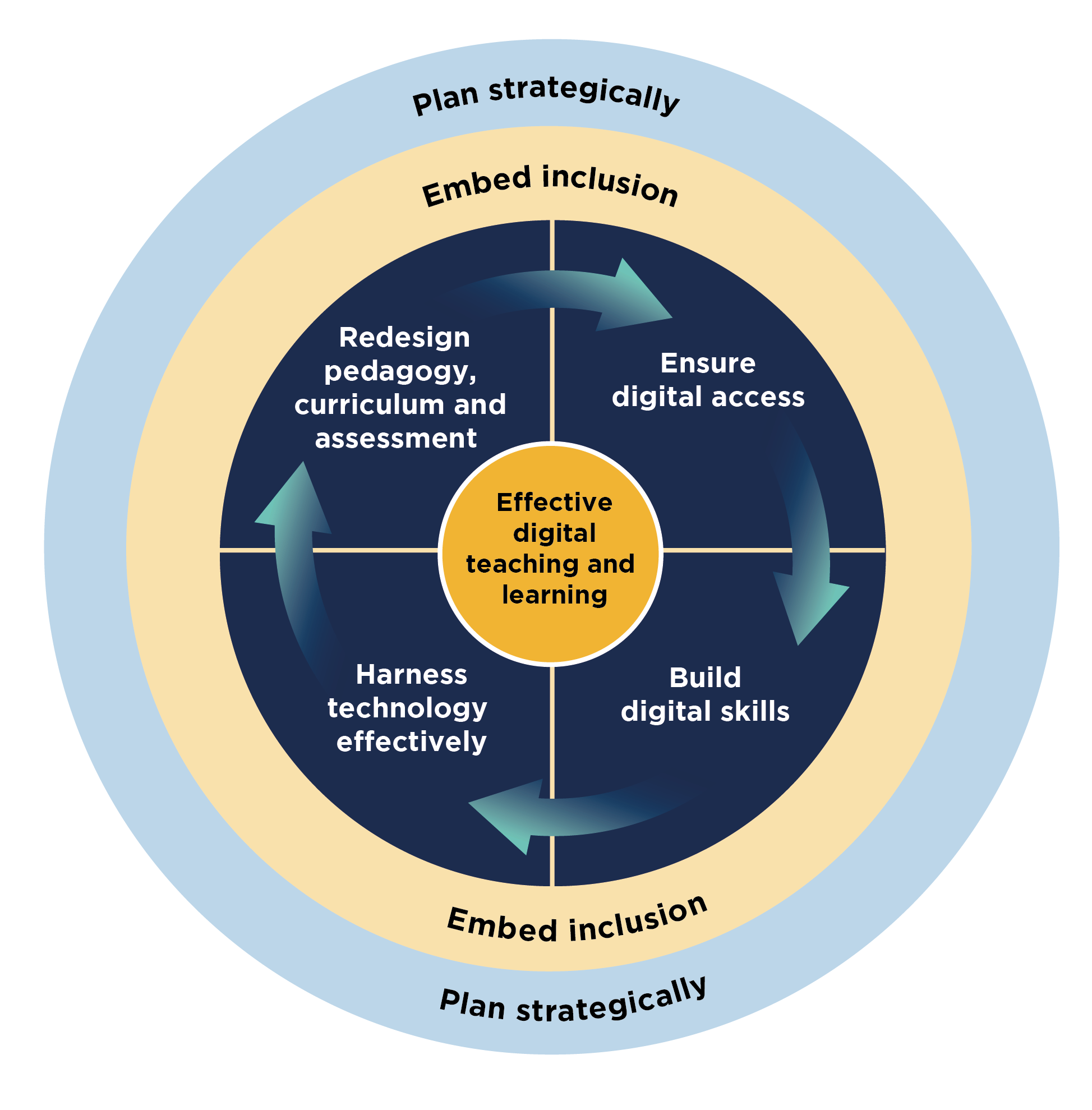
The paper provides a model for good digital learning and teaching. The model involves six core components to help universities define quality online and blended learning and then create a plan to achieve it:

  1. Digital teaching must start with appropriately designed pedagogy, curriculum and assessment.
  2. Students must have access to the right digital infrastructure.
  3. Good access enables staff and students to build the digital skills necessary to engage.
  4. Technology can then be harnessed strategically, rather than in a piecemeal or reactive way, to drive educational experience and outcomes.
  5. Inclusion for different student groups must be embedded from the outset.
  6. All the elements need to be underpinned by a consistent strategy. 

Recommendations

The lessons identified by the gravity assist paper and the core components generated from them have been condensed into a set of recommendations for high-quality digital learning:

  1. Redesign pedagogy, curriculum and assessment
    1. Design teaching and learning specifically for digital delivery using a ‘pedagogy-first’ approach.
    2. Co-design digital teaching and learning with students at every point in the design process.
    3. Seize the opportunity to reconsider how assessments align with intended learning outcomes.
  2. Ensure digital access
    1. Proactively assess students’ digital access on an individual basis and develop personalised action plans to mitigate any issues identified.
    2. Build learning and procure technology around the digital access actually available to students, not the access they would have in a perfect world
  3. Build digital skills
    1. Communicate clearly to students the digital skills they need for their course, ideally before their course starts.
    2. Create mechanisms that allow students to track their digital skills throughout their course and allow these skills to be recognised and showcased to employers.
    3. Support staff to develop digital skills by incentivising excellence and continuous improvement.
  4. Harness technology effectively
    1. Streamline technology for digital teaching and learning and use it consistently as far as possible.
    2. Involve students and staff in decisions about the digital infrastructure that will be used and how it will be implemented.
    3. Foster a culture of openness to change and encourage calculated risk-taking.
  5. Embed inclusion
    1. Review and evaluate whether provision is inclusive and accessible.
    2. Design inclusively, build a sense of belonging and complement this with tailored support for individual students.
    3. Adapt safeguarding practices for the digital environment
  6. Plan strategically
    1. Ensure a strong student voice informs every aspect of strategic planning.
    2. Embed a commitment to high-quality digital teaching and learning in every part of the organisation.
    3. Proactively reflect on the approach to the digital and physical campuses.

Six actions for 2021-22

Universities are currently planning the 2021/21 academic year, and the paper included a checklist of considerations that align with the recommendations.

  1. Assess students’ digital access on a one-to-one basis and address issues before learning is lost
  2. Inform students what digital skills they will need
  3. Involve students in designing teaching and learning
  4. Equip staff with the right skills and resources
  5. Make the digital environment safe for all students
  6. Plan how you will seize the opportunity for the longer-term

The paper is not regulatory guidance, but the clear message is that Universities should be moving to blended learning long-term. Institutions should be reflecting on the progress and challenges of the 2020/21 academic year and use the recommendations to plan out the future direction of their delivery model.

There is a big focus on digital access and skills for students. The access recommendations include assessing students’ digital access on an individual basis to put in place mitigations that allow them to continue learning, and design learning around the technology students have available. Simple solutions include:

  • Stating a courses technology needs for students before they start.
  • Creating accessible materials.
  • Considering bandwidth limitations.
  • Making asynchronous alternatives to live events available to students with limited or unreliable internet.  

The six actions do not present anything surprising, but this might represent an acknowledgement of the work that has been done this year by academics and professional services staff to move to online and blended learning. The one notable exception is within action three, to have a mechanism to involve students in learning design beyond the usual feedback opportunities. Each of the action points for co-design involves student feedback, so it is not clear if students should be directly involved in learning design or just an effort to increase the feedback collected and a need for increased responsiveness to it. What is clear is that student feedback needs to far more regular than mid-module and the end of module reviews, and academic will have to be prepared to update their delivery quickly in response.

You can read the full report on the Office for Students website. Let me know on Twitter what you think.

The MBA where your teacher is a machine

Quantic.edu, formally Smart.ly, is an online MBA programme built by a former CEO of the Rosetta Stone language learning company. It is based on self-paced learning driven by questioning and then supported by live sessions for traditional discussion of case studies and group work. The aim is to make high-quality education cheaper, quicker, cheaper, and better at delivering outcomes. They have taken the learning by testing idea that has made Rosetta Stone so successful and repurposed it to help people learn business skills. 

To make education cheaper, the programmes primary instructor is software, which is then supported by live classes with humans. Around 80% of the cost of a degree in America is staff costs, so replacing the lecture with self-paced learning allows Quantic to offer their Executive MBA for just $9,600, significantly cheaper than other similar programmes. The programme is also quicker, taking 11 months to complete compared to the 18-24 months of a regular executive MBA. 

The company offers its regular MBA for free to the student. It acts as a recruiter, placing its graduates in jobs with tech firms like Apple, Google, Amazon, and Facebook, looking for a talented individual, and then charges the company a recruitment fee. They have been innovative with their admissions process too. Once a prospective student applies, they have to go through the self-paced business Foundations’ courses in the period before their submission is accepted, with the engagement in these courses being a part of the acceptance criteria.

The real innovation is in their active learning teaching method. The website states that there is individualised feedback every eight seconds. The free course I took averaged around fifty words to a page and taught through questioning the questions’ difficulty gradually increasing as your confidence builds. These tests are presumably ‘low stakes’, meaning your answers are not recorded, but rather it’s part of the teaching method to give regular feedback and allow you to get it wrong and provide the solution to correct you.

Research – just as good as a traditional MBA

A July 2016 study by Stanford University academics compared learning from Quantics’s online model to on-campus MBAs for finance and accounting modules. Quantic participants took a pre-test, completed a self-paced course, and then took a post-test. On-campus MBA students took only the post-test. The study concludes that ‘Preliminary analyses show learners in the Quantic groups performed as well as or better than MBA participants at post-test.’

The Quantic students improve an average of 29 percentage points in accounting and 33 percentage points in Finance from pre-test to post-test. The average post-test score was 86% (accounting) and 82% (Finance), which was 11% higher for accounting and 1% higher for Finance than the on-campus MBA students’ scores in the same test. Students also like it; Quantic received similar net promoter scores to Harvard and Wharton MBA programmes in the study but has since improved on this by introducing their blended model that supports machine-driven learning with live classes.

“This study supports the assertion that some of the foundational accounting and financial concepts taught in traditional brick-and-mortar MBA program can be learned independently, online through Pedago’s targeted Quantic active-learning courses. Significant improvement in students’ knowledge can be gained in as little as two hours of engagement with these courses.” Quantic efficacy study

The self-paced courses are not enough on their own. The study suggests that the materials be used as part of an MBA programme that includes cohort-based elements alongside. The two suggestions were for the machine taught content to acts as introductory materials before the MBA starts or as prerequisites to live sessions in a flipped learning approach.

If acting as introductory materials at the start of the course, they can enhance students understanding of fundamental ideas in hard to learn areas or bring students up to a similar starting level—the Prerequisite work for blended-learning classes. If used as prerequisite learning between live sessions, it can leave instructors more classroom time to explore case studies and interact with peers in group work. 

Podego – The tesla of education – cheaper and quicker to learn 

Quantic is run by Pedago, a private company that aims to ‘build an end-to-end talent engine.’ They state that the fourth industrial revolution is leading to disruption of the labour market, removing or changing the jobs people do, and that technology can help people become smarter and re-skill in the new job market.

Education + career matching = Talent engine

Podego

They want to be the ‘Tesla of education’, using technology to making it cheaper and quicker to learn new skills, using technology and new approaches. One such method is eliminating the lecture and replacing it with discovery-based learning, replacing the lecturer with a computer, and focusing on interactivity and personalised feedback and progression, supported by live online classes with humans.

They state that Quantic is the worlds first accredited, machine taught degree and that it is specifically designed for access on mobile as that is where modern students want to learn. Their MBA is their first course and acts as a proof of concept and aim to move into teaching programming, blockchain, robotics, and other subjects that represent a skills gap in the economy. 

The Education company of the future

MAKE IT ACCESSIBLE: We’re mobile-first, platform-agnostic, self-paced, and easily-translatable into every major language.

MAKE IT AFFORDABLE: We remove the cost barrier and the heavy student debt burden, ensuring access regardless of socioeconomic status.

MAKE CREDENTIALS VALUABLE: We admit students for degrees and certificates based on prerequisites and prospects for employment.

TIE IT TO CAREER: We link education directly to its ultimate benefit, motivating financial gain, career advancement and personal fulfilment.

MONETISE ON THE EMPLOYER: We help companies match with the ideal job-seeking student, with the desired skills, education, and culture fit, paying upon a successful hire in our career network.

Podego

I highly recommend you sign up for their free courses and experiment with the Quantic learning method. If I took anything from exploring a couple of their introductory courses, it was the idea of tracking the number of interactions a student gets in their on-demand content. Self-paced learning in courses is essential to make the class time more valuable but can often rely too heavily on content and not enough testing. Moving to a metric of ‘seconds per interactions’ might be too much of a jump for current HE lecturers, but ‘minutes per interaction’ might improve the student experience significantly. 

Three Pedagogic approaches

Most people teach as part of their everyday lives and become good at it. They develop their teaching as an art, learning to explain things clearly, be patient, sharing just enough but not too much, and learning to read people to see if they have understood. For those who teach as a profession, we must take this art and add science to approach teaching systematically. This science helps us understand how learning happens, how to organise teaching to improve its effectiveness, what works for learners, and how we assess that learning occurred.

Pedagogy the method and practice of teaching that attempts to collect the science of learning into practical application. Three common types of learning pedagogies are: 

  • Didactic
  • Authentic
  • Transformative.

Didactic pedagogy is an effective method for large scale education in groups and teaching the basics of education, such as reading, writing, and discipline. It is a teacher-led approach where they, along with textbooks, are the authority of knowledge, and students absorb this knowledge presented to them often with little critical investigation or questioning of the source. University modules that involve a series of lectures and readings followed by a written exam where the student is questioned on the material is an example of didactic pedagogy.

Authentic pedagogy is learner-centred and expects the student to participate in the knowledge transfer and understand the learning through real-life experiences. There is less emphasis on learning through repetition but rather through building understanding from the ground up through self-direct inquiry, problem-solving, and reflection. This can be a slow and involved process, it requires a solid base of the basics, and not everything needs a deep level of understanding. Inquiry-based learning is an excellent example of authentic pedagogy. Students are given questions, problems, or scenarios and are expected to do their own research and then present their findings. 

Transformative pedagogy recognises the changing nature of technology and modern society and that knowledge may not currently exist to address what students need to learn. Instead, transformative approaches focus on problem solving, co-design, and producing new knowledge. One method of transformative pedagogy is project-based learning, where students are presented with a question or issue as a starting point; they then have work to produce a product to address it.  

These three teaching approaches have a place in the modern classroom and in preparing students for the world after university. There is a level of basic facts, knowledge and processes that are needed. Students then need to learn to question authority and established norms to develop a deeper understanding of the world. Finally, learners need to be able to deal with incomplete problems and generate new knowledge and approaches specific to the context they are in. If you were designing a higher learning course, you might even want to divide it into three discrete stages, building from didactic to authentic and finishing with transformative learning…  

The Knowledge Exchange Framework (KEF)

English universities have two core excellence frameworks, the REF and TEF, which judge the institution’s output quality. The REF or Research Excellence Framework assesses the quality of research at an institution, supports the allocation of research funding, provides accountability of that funding, and offers a benchmark for universities. The TEF or Teaching Excellence Framework assesses teaching quality by measuring how a university supports students to succeed and gain graduate-level employment or entry to further study. The performance of these two markers is directly linked to rankings and funding. A third Framework has been introduced that does not yet have any formal impact but might be a better way of measuring a university’s impact on society. 

The Knowledge Exchange Framework (KEF)

“The aim of the Knowledge Exchange Framework (KEF) is to increase efficiency and effectiveness in the use of public funding for knowledge exchange (KE) and to further a culture of continuous improvement in universities.” Research England

The Kef measures the impact of academic research by assessing the institution against the activities described in the HE-BCI survey data, a measure of interactions with businesses and the community. The range of activities includes involving industry and the public sector in research, consultancy, the commercialisation of intellectual property, and activities that have societal benefits, such as Continuing Professional Development, public lectures, and events. The HE-BCI data is currently also used to allocate the £200m Higher Education Innovation Fund (HEIF), and so the KEF may impact this allocation in the future.

The KEF looks at seven perspectives

  1. Research partnerships
  2. Working with business
  3. Working with the public and third sector
  4. Skills, enterprise and entrepreneurship
  5. Local growth and regeneration, 
  6. IP and commercialisation
  7. Public community engagement.

Currently, the KEF provides institutions with information about their performance in knowledge exchange to facilitate improvement. This information can also be shared with businesses and other users of knowledge for better access to universities. For those involved in making university teaching more flexible and integrating study with work, the KEF captures the delivery of Continuing Professional Development (CPD) courses, graduate start-up creation, and how universities support local growth and regeneration. 

The UK Government has been making significant efforts to increase the impact of higher education on skills, introducing degree apprenticeships and higher technical qualifications. Could this be the third deliberate step to further spread universities’ positive impact into the businesses and communities they site within? 

Free speech legislation for UK universities

Today the UK Government released a new law that puts a duty on universities to promote freedom of speech. The National Students Union (NSU), the Union of Colleges and Universities (UCU), and much of the UK press suggest no problem exists. They have responded that the government should be focused on supporting students. So what is the reason the government say we need the law and is there any evidence?

Freedom of speech and the free exchange of ideas are core to our way of life and are the foundation of democracy. The right to express opinions and share ideas is specifically there to protect people when these opinions and ideas are intellectually challenging, rebellious, dissenting, or controversy, no matter how uncomfortable. Voltaire famously defended free speech by saying ‘I may disagree with what you say, but I will disagree with your right to say it.’ This freedom of expression also covers the right for people to disagree with other peoples’ opinions and ideas openly, challenge and debate these publicly, protest, and, most importantly, speak truth to power.

Everyone has the right to freedom of opinion and expression; this right includes freedom to hold opinions without interference and to seek, receive and impart information and ideas through any media and regardless of frontiers. 

Article 19 of the Universal Declaration of Human rights

The new law places a duty on Universities to promote freedom of speech as apart of their registration for degree awarding powers and receiving public money. Universities that do not comply will be fined and are now open to compensating academics, students, and speakers that are dismissed due to exercising their free speech. The UK is not the first to introduce such a law; other countries have laws specifically to protect freedom of speech in universities, including Ireland and the United States. It is important to note that this law only covers speech that is seen as legal already, speech that incites violence is still illegal.

The government say they are worried about censorship and ‘cancel culture’ within universities where pressure is used to silence dissenting opinions. They state that no-platforming denies other peoples rights to hear opinions and the right to challenge what they say, and has a ‘chilling effect’ on freedom of speech and academic freedom. Examples of no-platforming provided in the first reading of the bill include Amanda Rudd, Germain Greer, Peter Tatchell, Peter Hitchins.

Several surveys suggest censorship or self-censorship due to fear is a big issue in universities. The government state that Britain has the second-lowest level of academic freedom in all of Europe, a survey by Civitas states that 35% of Universities imposed severe limits of freedom of speech, and UCU state that 35.5% of academics self-censor for fear of the negative consequences of saying what they believe. Spiked produces a free speech university rankings that provided evidence that over half of UK universities are curbing free speech.

Universities are in a difficult position, with 50% of the population getting a degree by the time they are 30, campuses are increasingly diverse. HE Institutions have tension between freedom of speech and creating a safe and inclusive environment that supports students’ success. University rankings and recruitment are heavily related to student satisfaction, and these institutions need to be responsive to student opinions. HE institutions are also under pressure by the government to address the attainment gap between different ethnic groups achieving a first or 2:1. As well as creating an inclusive environment that provides opportunity, universities need to provide academic freedom for staff and students to debate essential and controversial ideas in pursuit of truth.

The NSU suggests that while there have been isolated cases of no-platforming, the problem has been overstated. The government should be focused on supporting students through the much larger issues of the current situation. The UCU has also criticised the timing of the new law and questioned the existence of a problem. Universities UK has suggested that Student Unions should have the democratic freedoms to decide how they should promote freedom of speech. However, individual academics have spoken out on both sides of the argument, with some questioning the effects on the autonomy of universities and others about their fear of the ‘Woke hate mob’.

Suppose the problem is small and isolated as the Unions suggest. In that case, the new law is only strengthening the rights that are already there, ensuring students and academics human rights are protected. If there is a problem as any academics suggest, this should protect democracy and the pursuit of truth.