Character

The following is taken from the author’s foreword of Middle Distance Running by Percy Cerutty published in 1964.

I teach:
It is not important that we merely compete: that it is important that we endeavour to excel. That means, we do with all our ‘heart and soul’ that which we find at hand to do.
That we leave ‘no stone unturn’d’: no page unread: nothing frustrates us – since with the difficulty is the means of overcoming – and this once we have resolved upon a course of action.
There are much more priceless things than winning especially, if the victories be ‘unearned’ or ‘cheap’.
It is the ‘training’: the ‘way’, that is valuable. That winning is only evidence of something and may be valuable, or not.
That ‘value’ is only ‘earned’ when there has been self-discipline: exhaustive effort and the development of intelligence through experience and thought.
That without these factors preceding ‘winning’ – winning itself, rather than be an advantageous experience, can stultify the personality – not add to it.

I hold:
That suffering and dedication is the only way to understanding, compassion and courage.
That these three add up to a lovable personality, true withal, and the most priceless of all – character.

Percy Cerutty

Humility

Most of us are taught from a very young age to be humble. Religions tend to see humility as a virtue. In the Bible, humility is described as being without pride or arrogance and putting others before oneself. It is also the idea that God is all-powerful and that we are insignificant in comparison. I think the concept of humility is essential to happiness as it allows us to reflect on how lucky we are within our situations and genuinely appreciate those around us.

Humble: having or showing a modest or low estimate of one’s importance.

Oxford Languages

The opposite of humility is narcissism and hubris.

Narcissism: selfishness, involving a sense of entitlement, a lack of empathy, and a need for admiration, as characterising a personality type.

Oxford Languages

Hubris: excessive pride or self-confidence.

Oxford Languages

I was reading a book today and came across a definition of humility that emphasised recognition of greatness in others. This type of humility, where you recognise and publicly celebrate others’ excellence, is vital to Level 5 leadership from Jim Collins. 

Humility implies an aptitude to learn: a willingness to listen: a recognition of the greatness of others.

Percy Cerutty

We all want to develop mastery and become successful by whatever definition we give success. Success requires a deep level of belief in ourselves and what we can achieve. This personal belief does not sit well with the simplicity of the Oxford Languages definition of humility. It feels much easier and more appropriate to focus your efforts on others rather than develop humility by focusing on your ego. We need to understand how much we still need to learn, understand that everyone can teach us something, and appreciating other people and their skills as a route to humility. 

In a world becoming more narcissistic, be a person of humility. 

The 100-Up Exercise

I have been searching for ways to increase the amount I move since I began working from home, and my walking reduced significantly. The best movement practices are short to fit between meetings or tasks, require little or no equipment, and can ideally be carried out without changing outfit. If the movement makes me faster at running or on the bike, then even better. 

The 100-Up exercise is a short movement practice that you can do daily to improve running form, strengthen muscles, including the heart and lungs, loosens the limbs, and increases your daily movement. It can be done anywhere and in regular clothes, making it perfect as a movement break while working from home.

Walter George created the exercise and published it in a short book in 1880. George was an English middle-distance runner born in 1858, a holder of the mile world record between 1880 and 1893, and with a personal best time mile time of 4 minutes and 12 seconds. He worked from 7 am to 9 pm each day with a one hour break for lunch, and needed a way to supplement his training and keep active whilest at work. He would regularly perform the movement throughout the day when he moved around his workplace, creating opportunities to do 20 to 40 repetitions. Walter George credited his speed and stride length to the daily practice of the 100-Up.

Percy Cerutty in ‘Athletics: How to become a champion‘ suggests that runners should ‘run on the spot at terrific speed’ as an indoor activity if it is not possible to get outside. Many articles and books about his athletes also comment on regular, if not daily, ‘running in place‘ for 10-15 minutes to improve form and stamina. It might be possible to create smoother running form and a longer stride length by merely adopting the 100-Up exercise as a supplementary daily activity.  

The 100-Up exercise

The 100-up has three stages; each stage needs to be perfected before moving on the next. The exercise’s primary focus is as a carryover to running, so perfect form is required; knee to hip height each time and return the feet to the line without moving forward or backwards. At any point, if this form breaks down; the exercise should be paused.

You will need two parallel lines for all three stages, eight inches apart and 18 inches long. My floorboards are a perfect width, but you could put some tape down, or find another marker if needed. Your feet start with the balls of your feet on each line pointing directly forward and each rep your knee should reach hip height. Arms should hang naturally and remain by your sides for the first two stages.

Stage 1: Preliminary

Start by slowly lifting one leg ten times, trying to control your balance while getting your knee to the required height and returning your foot to the starting position for each rep. Do all the reps on one leg and then repeat with the other—progress when you can perform 30 reps on each leg correctly.

Stage 2: Minor

Repeat the preliminary exercise but this time alternate the leg you raise each rep. Start with ten reps – five with each leg, and progress over time to twenty, thirty, forty, and eventually one hundred. Start slow and gradually get faster as your strength and balance improves—progress to stage three when you can perform 100-Ups correctly. 

Stage 3: Major – The exercise proper

The final stage is the full exercise. Start with your feet in the same position but raise your heels, so you are on the balls of your feet. raise your knees to hip high and alternate leg each rep but perform the movement with good pace. Use your arms to mimic the running form, with relaxed shoulders, lifting the opposite arm to the raised knee and brushing your rib with your hand with the lowered hand. Try 20-Ups the first time – ten for each leg and concentrate on your form. Steadily add more reps over time as your stamina improves until you reach 100-Ups.

A long term pursuit

Treat mastering this exercise as a long term pursuit and do at least one set every day. If you run and have a GPS watch, see if your stride length is improving over time along with your competency in this exercise. If you are not a runner, the 100-Up exercise is an excellent way to add extra movement into your day and possibly get you interested in starting running as you learn the correct movement from the comfort of your home.

Have a go at the 100-Ups progression and contact me on Twitter with your progress.

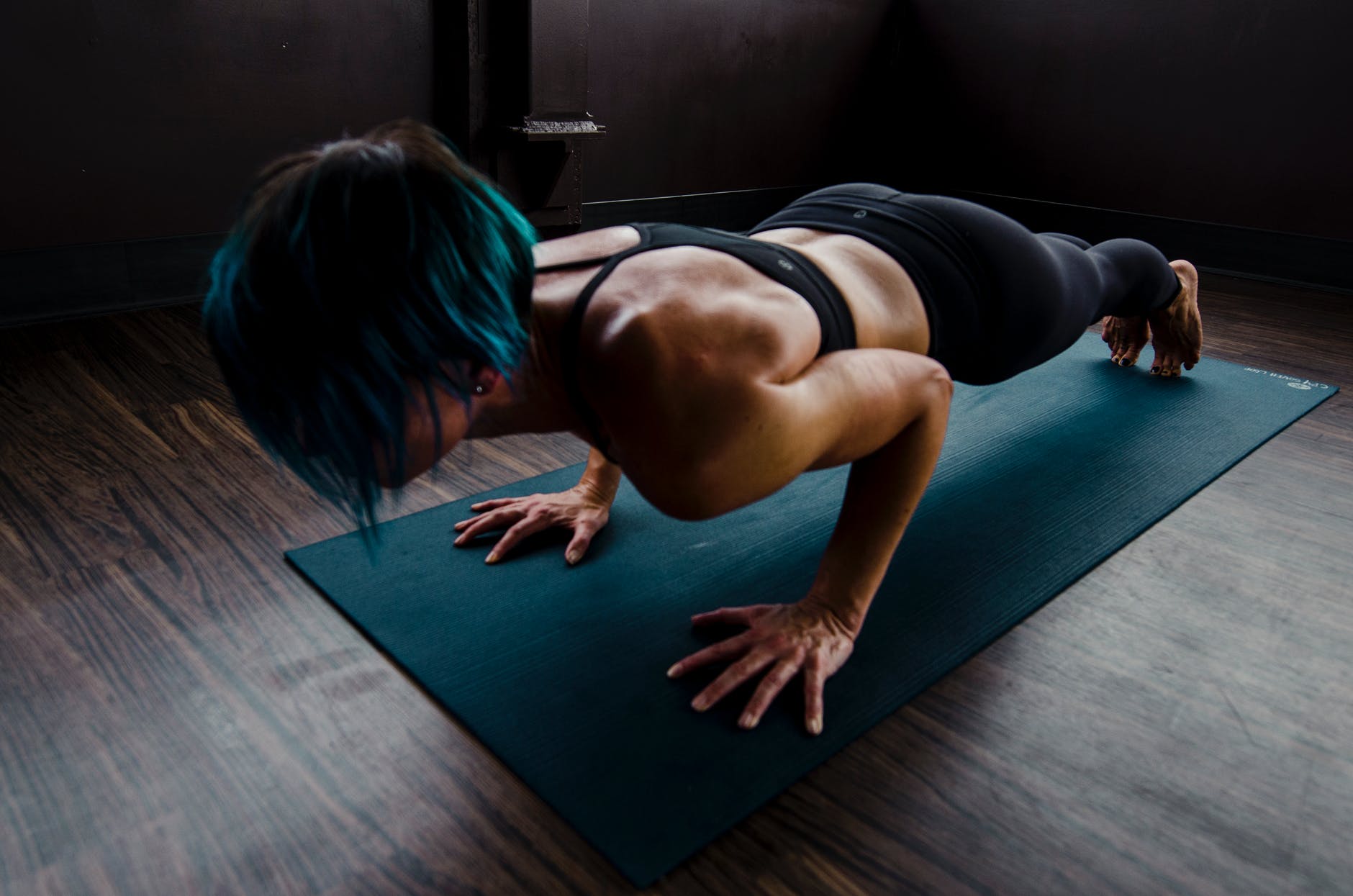
Is your health worth 1% of your day?

Photo by Karl Solano on Pexels.com

Arnold Schwarzenegger ran a campaign in 2012 called ‘Come with me if you want to lift.’ The campaign aimed to get as many people as possible, spending an hour per day working on their health and fitness. When listing the rules for success in his book, Arnold wrote that taking one hour to focus on your health is just 4% of your day. Spending this time each day will compound and lead to exponential improvements in your quality of life over time. Most people cannot find an additional hour in their day straight away, so he suggests to start with just 15 minutes or 1% of your day and as you progress, the amount of time you can devote to your fitness will go up.

Whenever you hear someone you care about complain about time, ask them if a longer, better life is worth 1%.

Arnold

Percy Cerutty had a similar idea in his 1967 book Be fit or be damned. Percy lists the three most essential areas for health; Pedestrianism, a strong core, and regularly picking up heavy things. For pedestrianism (walking and running), Percy suggested running just 15 minutes per day on most days, starting with walking, then progressing to run/walks, with a long term goal of running 2 miles in this time (7:30 minute miles). He also suggested doing one longer run per week that you build up to 10 miles. For core strength, Percy suggested doing ten sit-ups as soon as you get out of bed and working towards a goal of 100 in a single set with a second set in the evening before bed. The deadlift is the king of exercises, and Percy believed that everyone should do it regularly. He wrote that you should start with half your body weight on the bar and have an eventual goal for health of lifting your bodyweight 5-10 times off the floor.  

Dead-lifting, that is, heaving heavy articles whatever their nature may be off the earth, must be considered a primary physical function of homo sapiens.

In a society where most members can afford to have all or most of the modern amenities, the barbell should be considered an integral part of healthy living.

Percy Cerutty

Commit to spending just 15 minutes per day, every day on your health.

When asked by family and friends what they should do to get fit, I usually give two suggestions;

  1. Couch to 5k
  2. Andy Bolton’s kettlebell swing ladder.

The couch to 5k programmes, such as the free one provided by the National Health Service, progressively takes someone from not running at all to running five kilometres without walking in nine weeks. The kettlebell swings ladder starts with 5 minutes of exercise and builds up to 10 minutes, giving you some time to warm up with some air squats and glute bridges. Doing the couch to 5k run/walks three days per week, the kettlebell swings on the three other days, some sit-ups each morning, and a day off should give you a good start towards health. 

For January this year, I am giving the Yoga 15 challenge a go. If you are struggling to get a Kettlebell and it is too cold for you to start running, why not join me?

Once you are in a routine, have a go at some four minute movement breaks throughout your day to get you moving and deadhang from a bar for shoulder health. If you get a kettlebell and are doing the swings, add some overhead presses too. After completing your first 5k, have a look at what is next on your distance running progression.

Feel free to contact me on Twitter if you have any questions and let me know if you are committing to 1% of your day for your health.   

The Stotan Creed by Percy Cerutty

‘Stotans, will, by virtue of their philosophy, be nature lovers, with a respect and appreciation of all evolved or created things. They will appreciate the sanctity of creative effort both in themselves and in others. They will strive to understand the significance implied by reality, will be able to discern the real from the spurious, and see no anomaly in nudity, either in body or mind. But neither will they cast pearls before swine. Stotans, for all the reasons that their philosophy stands for hardness, toughness, unswerving devotion to an ideal, and many more – will look upon the sea as their pristine element and endeavour to associate themselves with their primeval source of life by going into the sea at least once per month in all seasons of the year. No practice is more disposed to toughen both the body and the morale than this. Stotans believe that neither the body nor mind can be maintained at a high pitch of efficiency unless sufficient regular rest is obtained, and aim at a daily average of eight hours sleep (that is for young men-older men need only six hours). Stotans, also will not be found in social places after midnight. Stotans shall regulate their lives so that at the end of a period, varying with the intensity of the effort, each shall realize that he has attained, without conscious striving, to a state of knowledge and a position of leadership in the community. It is axiomatic that only the pure can understand purity, only the cultivated appreciate beauty, and only the strong measure their strength. Therefore, only the self-disciplined can command genuine respect.’

Percy Cerutty

Taken from The Golden Mile: Herb Elliott’s biography as told by Alan Trengove. The word Stotan was made up by Cerutty by joining stoic and spartan to describe his philosophy to life and athletics.

The greatest miler in history

I finished the biography The Golden Mile: The Herb Elliott Story today. His mental and physical training would best be described as character building. If you like to run, think that modern methods are a little tame and want to read about how the best athletes trained in the ultra-amateur era of athletics, this book is a must-read. Once you are finished with this book, pick up a copy of Why Die: The Extraordinary Percy Cerutty ‘Maker of Champions’ to learn more about the famous Portsea camp and Cerutty’s coaching methods. 

Camp activities followed a fairly regular pattern. A typical day went like this: 7 a.m.: A five mile run before breakfast in any direction our whim took us, followed by a dip in the ocean. 8 a.m.: Breakfast of uncooked rolled oats (without milk) sprinkled with wheat germ, walnuts, sultanas, raisins and sliced banana. Perhaps a few potato chips to follow. 9 a.m.: Swimming and surfing or outdoor chores like chopping wood, painting and carpentry. Noon: Training and lectures at Portsea Oval, followed by another swim. 2 p.m.: Lunch – fish and fresh fruit. 3 p.m.: Siesta. 4 p.m.: Weight lifting. 5 p.m.: Ten mile run along dirt roads ending once more at the beach. 7 p.m.: Tea and a general discussion led by Percy on a wide variety of subjects. 11 p.m.: Lights out.

Herb Elliott

Herb Elliott, the 1500m gold medalist at the 1960 Olympics, is regarded as one of the greatest middle-distance runners of all time. The Percy Cerutty athlete saw running as the ultimate expression of the human body and embraced his coaches methods of natural eating, long runs in the mountains, sprints up dunes, sea swims, and weightlifting to develop extreme levels of strength and conditioning. Besides his physical abilities, mentally Elliot was a highly intelligent savage who through reading philosophy and embracing suffering, cultivated both unwavering confidence in his running performance and a will to win that saw him unbeaten in the mile and 1500m in his short adult career.

Most athletes imagine themselves at the end of their tether before they’re even seventy-five per cent exhausted. I was so determined to avoid this pitfall that if at any time I thought I was surrendering too soon to superficial pain I’d deliberately try to hurt myself more. In apparent conflict with this self-inflicted scourging was Percy’s theory that running should be a free expression of the body; that my body in motion, in the words of the song, ought to be doing what comes naturally. I trusted that my intelligence and enthusiasm would produce a happy compromise between this theory and my striving for perfection through pain.

Herb Elliott

While reading this book, I found my mindset changing towards heavy training. I started to see my quality sessions as an opportunity to push hard and embrace the pain a little more, driving with my arms and lengthening my stride when it started to hurt. I have begun heavy deadlifting and overhead pressing again on the journey to a double bodyweight deadlift and bodyweight overhead press, the standard that Percy Cerutty set his runners. And I have picked up my old copies of Stoic philosophy books and started to listen to Classical music from time to time including Beethoven’s Tempest III Allegretto when I need some inspiration.