How Charlie Spedding helped me run a faster half marathon time trial

Today I ran the half marathon distance as a solo time trial. This run was the final test at the end of a year where I had committed to getting better at running, setting a target of running 2000 miles to force consistency and improve my times. I had planned to do a race, but with all possible events cancelled, I drove to Nottingham and ran the ‘Big track’, the council provided tarmac and gravel route down the canal and back along the river. My goal was a sub-one hour and thirty five-minute half-marathon. I missed by 9 seconds but beat my previous best time by over four minutes and my february time by fifteen minutes.

…the council had provided hundreds of miles of tarmac for us to run on, and in the winter they even made it floodlit.

Charlie Spedding

I got a Kindle a few months ago to help increase my reading volume and chose a running book on sale to be my first read. I had not heard of Charlie Spedding, despite him being a successful English distance runner, London Marathon winner, and Olympic medalist. The book is an honest account of Spedding’s career, and it has transformed the way I think about my training.  

There are some running gems in the book. Spedding states that running well depends on physical fitness and your ability to perform. Their natural ability will determine each individuals peak level of fitness, but the aim is to get as close to that peak as possible with training. That individual’s ability to perform is determined by their confidence, determination, and motivation. 

Spedding also writes about his self-image. He needed to move from a place where his subconscious self-image of ‘running quite well but not winning’ became one of someone that achieved great things. He went through a process where we changed his attitude towards what he was capable of and moved from just training hard to expecting more from himself and so doing things in a ‘better and different way’. He began to think of himself as a champion, and so his actions began changed to mirror this mindset. 

But if I could get this right, when I thought about the big race I would say to myself, ‘this is a huge test for me, it will be very difficult, in fact, to do well I will have to run the perfect race.’ To this my subconscious mind would respond, ‘the perfect race? No problem, I do that all the time.’

Charlie Spedding

He began to focus on optimum training rather than hard training; ‘to do enough but not more.’ The word ‘optimum’ did not fit with his new mindset, so he changed it to ‘perfect’ training and set about perfecting his physical fitness and ability to perform. He would measure his improvements based on his previous performances, and broke his progress into stages by setting lots of goals.

…on my pad I wrote ‘I am going to think like a caterpillar.’ The caterpillar spends its time surviving. It hides from birds and eats leaves, but it is one of the most ambitious creatures on the planet because all the time it is thinking, ‘one day I am going to grow beautiful wings and I am going to fly.’ Charlie Spedding

Charlie Spedding

The most memorable part of the book for me was when the author finds himself in a pub with a notepad and a pint of beer and decides to make a plan. He writes three headings on the page; What do I want? Why do I want it? And How much do I want it? He then writes a list of what he needed to do; ‘Change my vocabulary. Aim for perfection, Know what I want, why I want it, and how much I want it. Use my imagination. Try to feel fantastic, and think like a caterpillar.’ 

Success is measured by how much I fulfil the talent I was born with.

Charlie Spedding

This book found me after my time with a coach had just ended and with no races on the horizon. I was struggling to keep up the motivation to run six miles a day to keep my annual milage target on track. After reading the parts about focusing on improving times based on previous performances and striving to fulfil personal talent, I created a set of goals to work towards as stepping stones towards being a better distance runner. I found a plan in Brad Hudson’s book to reach the next step on my journey – a 1:35 half marathon and focused on performing each workout perfectly. 

Today was the day of my test. I had a quiet morning, I avoided any negativity (my newsfeeds), and I drove quietly to where I was to start running. I told myself that to run my goal time, I would have to run a perfect time trial, but that was ok because I had been practising perfect for months. I narrowly missed my goal today, but if it were easy, it would not be fun. The search for the perfect run continues.

Pick up a copy of From last to first by Charlie Spedding; you will not be disappointed. Let me know what you are up with your training on Twitter and connect with me on Strava.
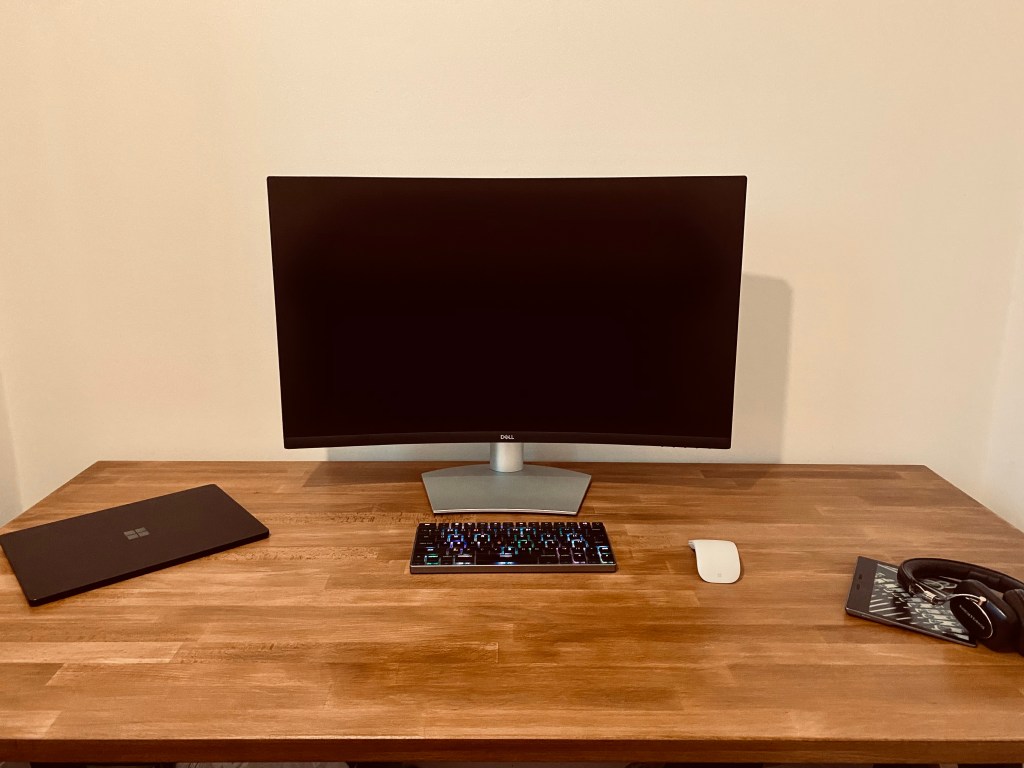
My perfect desk setup

I spend a lot of time at my desk. Working from home for the last nine months has allowed me to play with my setup and tweak it gradually. I can’t tell you if it improves my productivity, but it is comfortable, and it does look cool.

Today I got a new desk as a Christmas present. I like a large space to work, and I love having an authentic wood surface. I thought about a standing desk, but with the volume of training, I like to sit when I am working. As long as I keep up my 4-minute movement breaks, my 30 second hangs three times per day, and sit correctly; I don’t feel the need to stand all day to be healthy. I have gone with the GERTON Beech Tabletop (155×75 cm) with some trestle legs from Ikea and have varnished it with a dark oak finish. 

There is something about Eames chairs that is special. I originally wanted the soft pad low back design as they look great, but I have never been a big fan of too much padding. I ended up going with the high back ‘managers’ chair and found a high-quality replica from By Kallevig.

The monitor is the computer. I have tried multiple screen setups including double 27-inch widescreen monitors, but I was never a fan of the bezel. An alternative would be a 49-inch ultrawide screen, but I like to have a bit of hight too. I have settled on a 4K 32-inch curved monitor from Dell. The size gives me space for two windows side by side, and the screen is easy on the eyes.

The built-in keyboard on both my laptops are great, but I use an external device when working at my desk. My current choice is the wireless Vinpok Taptek, is the first mechanical keyboard I have used, and I am not going back. It is a pleasure to type with and has colourful backlights that respond to the keys that add a nice touch. It has a mac layout which can be an issue when using my work laptop, but I like it and can’t bring myself to replace it with a PC layout alternative. 

I have had an apple magic trackpad for years, but last year I was given a Microsoft Surface Arc mouse by work, and I have been using that instead. It feels great in hand, has a touchpad on the front that gives you lots of control, and snaps flat for travel.

For my laptop, I rotate between my recently purchased work-issued i7 Surface Laptop 3 and my personal, and much older MacBook Air. Of the two, I prefer the Microsoft device and use the Surface almost exclusively. It has a high-quality touch screen, plenty of power, and I find Windows to be really useable for working.

For music, I have a pair of B&W P5 headphones. I have been a die-hard fan of Bowers and Wilkins since I was lucky enough to visit Abby Road recording studios at school as part of a tour of EMI set up by the British Arts Council. In every room, they had 800 series speakers that sounded out of this world, and so I have not bought speakers from another company since. 

Now I have my new desk; I want to add a desk plant to lighten up the room and add some green and have been looking at Little Botanica for options. After that, possibly some speakers? Perhaps a pair of Formation Flex desktop speakers with a Formation Bass sub? We shall see…

Let me know of Twitter about your setup.

And breath… Term one is over

Today marks the start of a two-week break for my team and me after nine months of intense work. We set out at the beginning of the year with an ambitions five-year plan to weave digital and in-person learning seamlessly across all courses at the university where we work.

In March, we pivoted to help move all teaching and assessment online. In June, we started a programme to offer one-on-one support for all modules in the university to move to a blended learning model within the government social distancing guidelines. We carried out over a thousand design workshops, countless emails and helpdesk tickets, and wrote or recorded hundreds of guides, webpages, and communications.

Term one is now over, and higher education is changed forever. Our initial plan is more or less complete, and we start to look at what is next. Will we ever see regular mass lectures again? Will students expect a HyFlex model where they chose online or in-person on a session by session basis? Or are we at a tipping point where new models of learning are about to be launched with methods we have not yet thought about?

As I sit here next to my Christmas tree, beer in hand, and Michael Buble singing ‘It’s beginning to look a lot like Christmas,’ I am thinking about the great people I work with and the things that they have achieved this year, and I can only smile. These questions are for tomorrow or for January. The next two weeks are about family, food, and that half-marathon time trial on Sunday that is really going to hurt.

Who pays for Higher Education?

One of the biggest questions in HE currently is ‘who pays’. In the UK, students can get government-backed loans for both undergraduate and postgraduate long courses with the Government topping up the course costs. These loans act more like a graduate tax than a traditional loan, with payments only starting once graduates earn above a threshold income and remaining totals cancelled after 30 years.

To support the 49% of students that do not go to a university, in 2016, the British Government introduced the Apprenticeship levy to help fund apprenticeship training. Companies with an annual pay bill of over £3 million pay the levy at a rate of 0.5% of the total bill. This money can then be claimed back for the hiring of apprentices. The levy has led to the growth of higher and degree apprenticeships where student employees can do on the job training for 80% of their time and use the remaining 20% for formal study towards a degree or similar qualification from level 4 to 7.

The next piece of the puzzle is short courses for vocational or technical skills. The idea is that individuals can take short courses to boost their skills to help them get a job and that these ‘micro-credentials‘ can be stacked together into larger qualifications as a signal of proficiency in a particular area. Currently, these qualifications are paid directly by individuals or their employers, but this might be changing.

The UK Government has been making noises about lifelong learning funding or loans to be used for collections of shorter courses over a lifetime. Providers are looking for easier ways for people to pay for courses including instalments or even free upfront but then paying through a percentage of income after graduation for a pre-specified timeframe.

Today I had an email from a private company offering a partnership for an interest-free ‘learn now, pay later’ services similar to those eCommerce sites have started to add to their checkouts. The economics of HE is changing, and the question of who pays becomes more critical. People are retiring later, and technical skills become more important to get into and maintain high-income roles, and employers are struggling to find people with relevant skills. If we can make it easier, and cheaper, to gain the skills needed, society and its individuals will benefit.

Let me know on Twitter if you have found any interesting ideas on paying for higher education.

Level 5 Leadership

In the book Good to Great, Jim Collins presents his research into companies that outperformed the market over a significant amount of time. One of the common themes that emerged from most of these companies was the idea of level 5 leadership. These successful companies had leaders with the capabilities to develop greatness within a company through ‘a paradoxical combination of personal humility plus professional will.’ 

The five-level classification hierarchy of leaders:

  1. The highly capable individual
  2. The contributing team member
  3. The competent manager
  4. The effective leader
  5. The executive

Professional will is described as an ability to get things done, not taking personal credit to successes, generating excellence, and planning success beyond their duration at the company. Personal humility is described as avoiding praise, calm work, emphasising standards over inspiration, a focus on company success over individual success, and taking personal responsibility when things go wrong.

The five levels are a hierarchy, so to be a better leader, one approach would be to work through each level. Alternatively, developing the capabilities of professional will, and personal humility is an excellent place to start to become a high performing leader. A few areas to think about include;

  • Obsessively work on your productivity and create a system
  • Publicly give credit to those that deserve it when things go right
  • Clearly define excellence within your area
  • Start succession planning for your role and develop those under you to be able to progress when the time comes
  • Be hyper-organised and understand risk in your area so you can react to things calmly
  • Use company metrics as a measure of success and see personal heroics in a project as a failure of planning
  • Review your decisions and actions when things go wrong and do what is required to fix them

Get in touch on Twitter if you have ideas about how you can work up the hierarchy.

Strategy vs Tactics

Strategy: a general plan to achieve one or more long-term or overall goals under conditions of uncertainty.

Wikipedia

Tactic: a conceptual action or short series of actions with the aim of achieving a short-term goal.

Wikipedia

A strategy is a general long term plan that may contain a set of goals. The strategy will incorporate multiple tactics, each designed to achieve a specific goal. Many people use the two words interchangeably, but this is not correct.

Recording high production value Youtube videos

It is possible to get started making youtube videos with just an iPhone, webcam, or an entry-level DSLR. This post is going to cover the equipment needed to produce YouTuber style videos with good production value.

The best camera is the one that’s with you.

Chase Jarvis

There several things that you will want to get right before investing in expensive gear and most of them will take time and skill but little or no money. The first is quality content, you can have high production value, but if your content is weak, then it will be a waste of time. You can’t polish a turd as they say. People will forgive low-quality video, but they cannot ignore low audio quality. Find a quiet place to film, make sure that the mic is not picking up any external noises, and remember the closer the mic is to your mouth, the better the quality will be. Finally, plan your background.

In photography, the term framing refers to how you design what is in the picture. You will notice that academics usually have a bookcase in the frame to infer that they smart, or there might be some plants and exciting objects on a bookcase in the background to set a scene. However you frame your shot, make sure no lines coming out of the back of your head and google the rule of thirds to understand you to position a portrait. 

An important point to make is that whatever camera you use will have different resolution settings make sure you set these up to record in the quality you want. An excellent place to start is with a 4K resolution, a framerate of 25fps, shutter speed 1/50, a 1.8 aperture (this will depend on your lens), and a 160 ISO for a cinematic look with a slight blur to the background. You can set up the white balance and picture profile too but read up on the camera you have to get the best quality you can out of it.

The Camera 

There are many high-quality cameras targeted at youtube content creators; Sony’s Alpha 7C, the upgrade to the popular Sony A7iii is an excellent choice if you have the budget. Sony has added a rotating monitor and updated the autofocus specifically for video creators. The addition of a Sony 35mm F/1.8 or 25mm F/18 G-Master lenses works well for talking head videos. A quality tripod that can handle the weight of the camera and allow a variety of positions is a good idea. For audio, the ECM B1M mic that connects to the camera via the flash adapter or lapel mic will work, and for lighting an Aperture 120dII with the light dome II softbox will create soft light.

To edit your videos, I suggest Premier pro and access to a stock video library such as storyblocks. A couple of 4+ TB solid-state hard drives will keep everything backed up and be fast enough to edit some video directly off it. However, it is a good idea to have the video stored on your computer during editing to make sure it can be accessed without any lag.

Good luck and let me know on Twitter if you select this gear or an alternative. 

Very short, very steep, very fast hill sprints

To get faster, you need to train all the muscles used in running, according to Pete Magill in his book Fast 5k. Most of us distance runners are good at training at multiple paces to support this idea but neglect the very short burst speed that develops power. Brad Hudson suggests in Running faster to add to your weekly schedule ‘very short, very steep, very fast hill sprints to build strength and power.’ Building power will produce a longer stride, a shorter contact time between the foot and the ground, and increase muscles resistance to fatigue. 

There are two ways to increase strength and power; the first is to increase muscle mass; the second is to increase the percentage of muscle fibres that are activated in a given movement. High-performance distance running is highly connected to relative strength, so to get faster, it is better to focus on muscle recruitment rather than get more muscle. The good news is that most people can only recruit 50% of their muscle fibres at any one time, so there is a lot of room for progress.

Power is movement-specific as it is related to coordination. Running power needs to be trained through running or movements very similar to running such as single-leg strength and plyometrics once a base level of strength is achieved. Maximal effort sprints are a great way to train this running specific power. Performing these sprints up a steep hill will reduce the impact and reduce the risk of injury and force greater muscle recruitment.

Go to the steepest hill you can find and run up it as fast as possible for between 8-12 seconds. Walk down to recover and then repeat up to 10 times.

Adding maximal effort hill sprints to your week

The essential point is that to build power; the sprints need to be maximal. Maximal-effort means run as fast as you possibly can run. To help make these maximal, use the steepest hill you can find and recover by walking down to give your muscles a chance to recover enough to go 100% again. Maximal effort running will cause unconditioned runners to get injured so add these gradually to your programme, starting with a single sprit the first session. The sprints should be performed directly after an easy run, once per week, every week. Hudson suggests doing them the day after your long run. 

A simple progression for maximal effort hill sprints

Sprints should be performed directly after an easy run up a very steep hill. Stop if you are no longer able to produce a maximal effort.

  • Week 1: 1×8 sec hill sprint
  • Week 2: 2×8 sec hill sprint
  • Week 3: 3×8 sec hill sprint
  • Week 4: 4×8 sec hill sprint
  • Week 5: 5×8 sec hill sprint
  • Week 6: 6×8 sec hill sprint
  • Week 7: 7×8 sec hill sprint
  • Week 8: 8×8 sec hill sprint
  • Week 9: 10×8 sec hill sprint
  • Week 10: 8×10 sec hill sprint
  • Week 11: 10×10 sec hill sprint
  • Week 12: 10×10 sec hill sprint
  • Week 13: 8×10 sec hill sprint
  • Week 14: 5×10 sec hill sprint

Ready player two (spoiler alert)

Warning! This post will spoil both books, so read them first.

I was a big fan of Ernest Cline’s first two books, Ready player one and Armada. I enjoyed the Ready player one film too although I am happy I read the book first. When I saw that the sequel was being released in November, I was excited to see where Cline would take the Oasis. Will Wheaton reads all three books on audible, and I enjoy what he adds to the text so I would recommend getting them on Audible.

Ready player two is a story about a general AI created from a brain scan of the creator of the Oasis, a virtual reality world that most of civilisation is addicted. The book introduces a possible post-human future where people can upload their consciousness to the simulated world and live on as a digital version of themselves after they die. Another idea introduced is that of people recording their experiences through brain scans. Others then can play them back, experiencing them from inside the other person’s body, with the feelings and emotions, providing empathy, something that might solve many of the current political and social arguments.

People not being ready for accepting digital versions of others is mentioned, especially as the first version of this goes mad and holds the whole virtual world hostage. Cline, however, does not talk much about the ethical implications. Are humans meant to live forever? What happens to a persons decision making when you can’t die? A statement is made towards the end of the book about a person’s mind and body are two separate things, but is this true, and are there implications of separating them?  

Altered carbon has a similar premise, but as it is based in the physical world and explores the magnified inequalities that result from the costs of moving from body to body and the ethical and religious issues of living forever. The marginal cost of digitising the mind and living forever in a computer is much cheaper and so more accessible. This would avoid some of these issues, but income inequalities will be exacerbated, and a two-class system of AI avatars and blood sacks is sure to result. I hope this is the plotline for Ready player three.

This is a great book, especially if you were born in the 80s and get all the cultural references, I highly recommend you read both Ready player one and two. If you have read or watched Altered carbon before getting to the second book, it might make you think a little more about the ending.

Let me know on Twitter if you have read the second book and what you thought of it.

How not to get fat

The great thing about physical training is that if you show up consistently and do the work, you get stronger. Today was the first test day for my deadlift in years. I was successful with my target of 142.5kgs, the total amount of weight I currently have in my gym. This is not the heaviest I have ever lifted, but probably one of the most satisfying. I am older, lighter by at least 12kgs, and running higher mileage than ever but still able to move a ‘reasonable’ amount of weight. I am stronger in the bench and pull-ups than ever before too. More importantly, my body feels good. 

At the start of the year, I set myself a challenge to take my training seriously. I do not have kids or other heavy commitments outside of work other than being a responsible adult and husband. I have taken advantage of working from home and no commute to train two times per day for much of the year, adding rest where needed. I have used this time to work on ticking off some strength standards as well as running faster. These include 100kg bench press, 13 strict pull-ups, I can perform solid reps of dips, press double 24kg kettlebells overhead for ten reps, and many others.

Despite two good training sessions per day, usually a 6+ mile run, in the morning or since the weather turned, at lunch, and a strength and mobility session in the evening, I have looked fit and healthy but not great. Part of this is my insanely sweet tooth, lack of discipline in my eating, and ready access to my kitchen at all times. Still, part of it is something most people working from home since march will be familiar with, I spend the rest of the day sitting down. About six weeks ago, I wanted to make some changes to what I do outside of this 60-90 minutes per day of exercise to try and look as good as I feel.

James A Levine defines Non-exercise activity thermogenesis (NEAT) as ‘the energy expended for everything we do that is not sleeping, eating or sports-like exercise.’ NEAT is your general level of activity; the walking from your car to the office, taking stairs over the lift, and walking to someone’s desk instead of sending an email. If you are a knowledge worker and have been working from home for the last nine months, your NEAT has probably taken a swan dive, and your body has suffered for it.

I have been artificially adding back into my life this general activity. I started with an idea from Percy Cerutty; set of 10 sit-ups or more when I first wake up and then 5 minutes of activity to get my heart rate up after sleep. This 5 minute has been anything from some push-ups and squats to light kettlebell work, some stretches, or my latest choice of a few upper body movements with an exercise band.

Next, I started hanging from a pull-up bar for 30 seconds three times during the day. Once these were habit, I took an idea from the Gymfit newsletter and started to add short 4-minute movement breaks between meetings or after a couple of hours of intense work. The movements might be a few stretches, some bodyweight movements like 20 press-ups, some planks, or even a little sing and dance to Hey Jude by the Beatles. GymFit suggests setting a timer every 45 minutes and adding one of these breaks, but I have started to put my meetings to 50 minutes instead of an hour and use the few minutes between to do some movement.

Tomorrow, wake up and do a set of 10 sit-ups. Repeat every day for 200 days. After the first few days add one 30-60 second plank after your shower and before you work. Commit to adding movement breaks randomly and without planning. Your body will thank you.

Let me know how it goes on Twitter